Which animals can you see in Uganda? From the Big Five to gorillas and chimpanzees
A safari in Uganda gives a chance to see an incredible variety of African animals in the wild. Thinks of elephants, lions, leopards, giraffes, zebras, crocodiles, and hippos, on a safari, but also chimpanzees, golden monkeys, and mountain gorillas in rainforests. And then there is the remarkable shoebill stork. The beauty of it is that you can come across all these animals on a single trip.
If you want to see animals in Uganda, will tell you where you have the best chance, which national parks we recommend, and what makes Uganda such a special destination for wildlife safaris.
Which animals can you see in Uganda?
You will see an enormous variety of wildlife in Uganda. Besides the famous Big Five animals, we have giraffes, zebras, hippos, crocodiles, hyenas, warthogs, various antelope species, and over 1080 bird species, among others. But Uganda, of course, is best known for its primates. Here, you can encounter mountain gorillas, golden monkeys, and chimpanzees, all in their natural habitat.
We have over 10 national parks in Uganda. And where you go makes a big difference to the animals you are likely to see as not every animal can be found in every national park. Lake Mburo National Park, for instance, is known for its zebras, giraffes and impalas, while Queen Elizabeth National Park is mainly known for lions, leopards, elephants, and large numbers of hippos. Murchison Falls National Park is another excellent destination for elephants, giraffes, lions and other savannah wildlife.
So, the route you choose is very important. By combining the right wildlife parks and activities, the chance of seeing almost all of Uganda’s famous animals is exceptionally high.
Which animals can you see where? Our practical overview
1. Lion
- Best places: Murchison Falls, Queen Elizabeth and Kidepo Valley National Parks
- Best way to see them: Nature game drive
- Chance of seeing: Very high
2. Leopard
- Best places: Murchison Falls and Queen Elizabeth National Parks
- Best way to see them: Nature game drive
- Your chances of seeing: High
3. Elephant
- Best places: Murchison Falls and Queen Elizabeth National Parks
- Best way to see them: Nature game drive or boat safari
- Your chances of seeing : Almost certain
4. Buffalo
- Best places to visit: Murchison Falls, Queen Elizabeth and Kidepo National Parks
- Best way to see them: Nature game drive
- Chances of seeing: Virtually certain
5. Rhino
- Where to go: Ziwa Rhino and Wildlife Ranch
- Activity: Rhino tracking on foot
- Chances of seeing: Almost certain
6. Giraffe
- Best places: Murchison Falls and Lake Mburo
- Best way to see them: Game drive or walking safari
- Your chances of seeing them: Virtually certain
7. Zebra
- Best Places: Lake Mburo and Kidepo Valley National Park
- Activity: Game drive or walking safari
- Your chances: Virtually certain
8. Hippo
- Best places to visit: Queen Elizabeth and Murchison Falls National Parks
- Best way to see them: Boat safari
- Your chances: Almost certain
9. Crocodile
- Best places to visit: Queen Elizabeth and Murchison Falls National Parks
- Best way to see them: Boat safari
- Your chances: Very high
10. Mountain gorilla
- Where to go: Bwindi Impenetrable Forest and Mgahinga Gorilla National Parks
- Activity: Gorilla trekking
- Your chances of seeing them: Almost guaranteed
11. Chimpanzee
- Best place: Kibale Forest National Park
- Activity: Chimpanzee trekking
- Your chances: Virtually certain
12. Shoebill stork
- Where to look: Mabamba Wetland
- Best way to see it: Boat trip with a birding guide
- Your chances: Very high
13. Cheetah
- Where to go: Kidepo Valley National Park
- Activity: Game drive
- Your chances of seeing them: Very small.
These chances apply to a carefully-planned tour, with visits to the right national parks and enough time set aside for the different activities. This is particularly important when looking for lions and leopards. Your chances are naturally better when you go on multiple game drives with an experienced guide rather than relying on just one game drive.
Of course, these are wild animals, so there are no guarantees. However, with the exception of the cheetah, most of the animals in this overview are regularly spotted on well-planned Uganda safaris.
Where can you see the Big 5 in Uganda?
The Big 5 are lion, leopard, elephant, buffalo, and rhinoceros. Interestingly, the name has nothing to do with their size. It dates back to the days of big-game hunting in Africa, when hunters used it to describe the five animals they considered most dangerous and difficult to hunt on foot. Today, the term has taken on a very different meaning. It has become one of the most recognised expressions in safari tourism, and seeing all five is high on the wish list of many travellers visiting Africa. In Uganda, you can admire all five. In fact, during a well-planned tour, the chance of seeing the complete Big Five is particularly high.
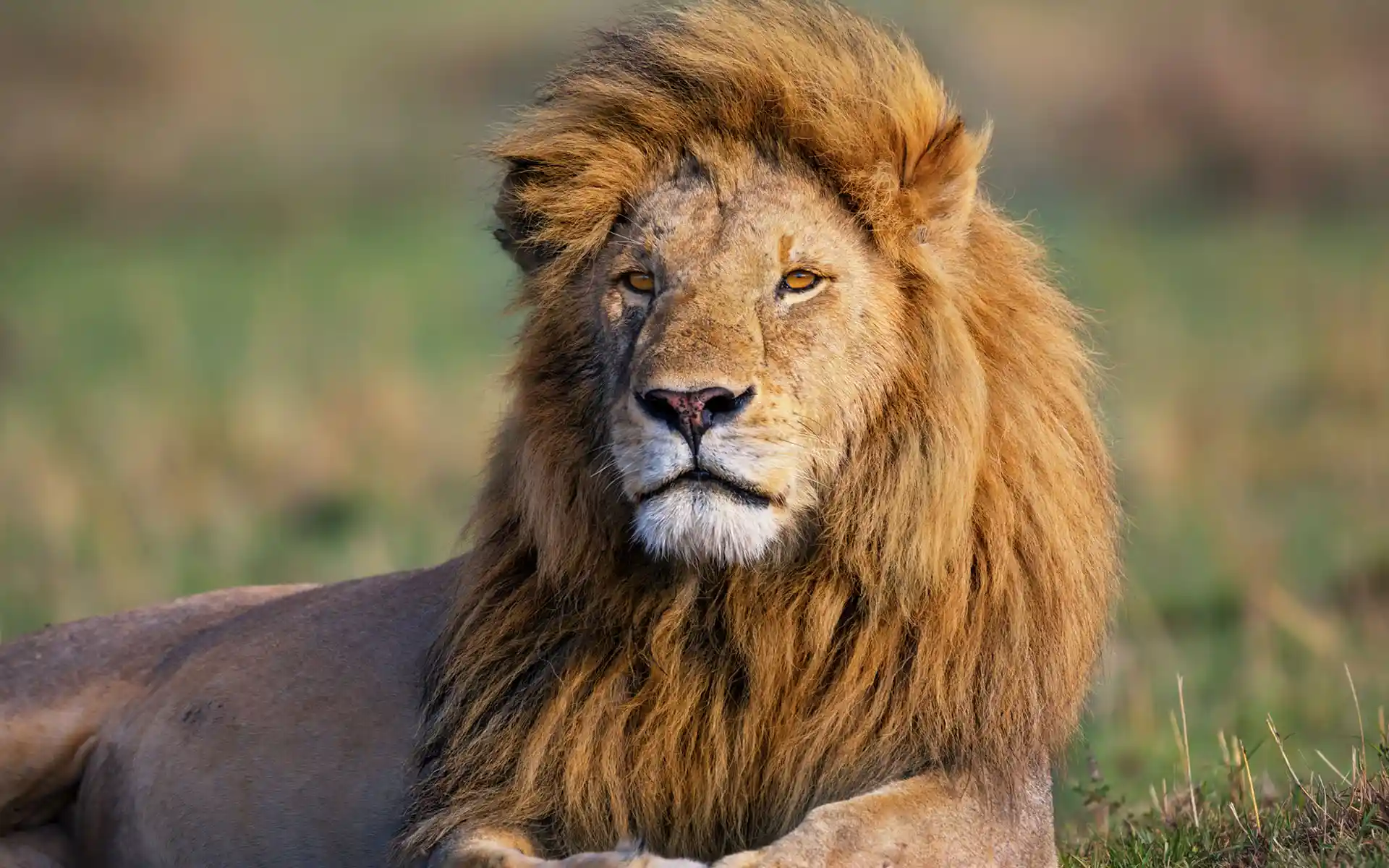
Lions and leopards: The Highlight For Many Travellers
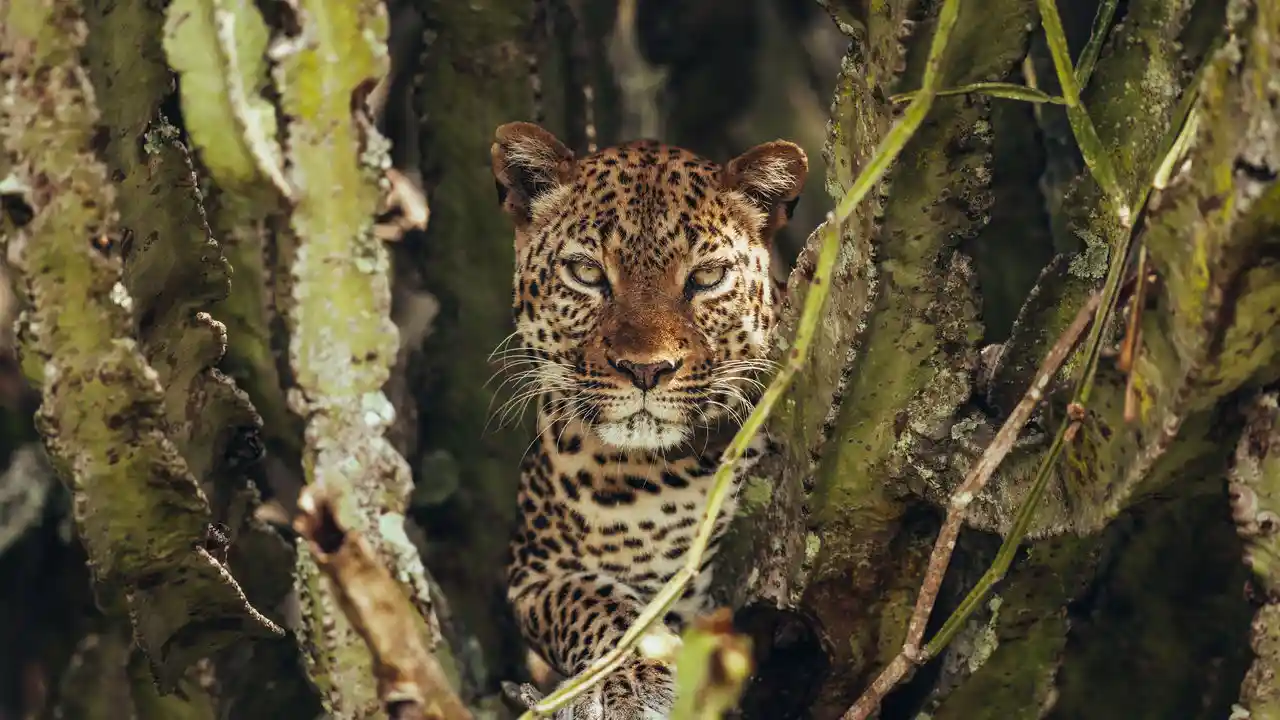
For many travelers on African safari, big cats are among the animals they most hope to see.
And we understand why. Take the leopard, for instance. That beautiful coat, the perfect marked spots, and the way the animal moves. Sometimes you might find one lying peacefully in a tree; sometimes you may see it walking right past your car. When you see a leopard at a close distance, you may also be surprised by how big it actually is.
Leopards are masters of hiding. But they are regularly spotted during our trips. Murchison Falls National Park and Queen Elizabeth National Park, in particular, offer the best opportunities. Our guides know these parks well and know where to look. Lions are also regular encountered in both parks.
Additionally, in the southern section of Queen Elizabeth National Park (Ishasha), there are lions that often climb trees. Seeing one resting in the branches of a large fig tree is quite something.
On a good single game drive, you might see several lions and even a leopard in the same outing. On other days, you need more time and patience. That is simply how wildlife viewing works. By visiting the right parks and going on several game drives, you give yourself an excellent chance of seeing both.
Elephants: impressive, no matter how often you see them
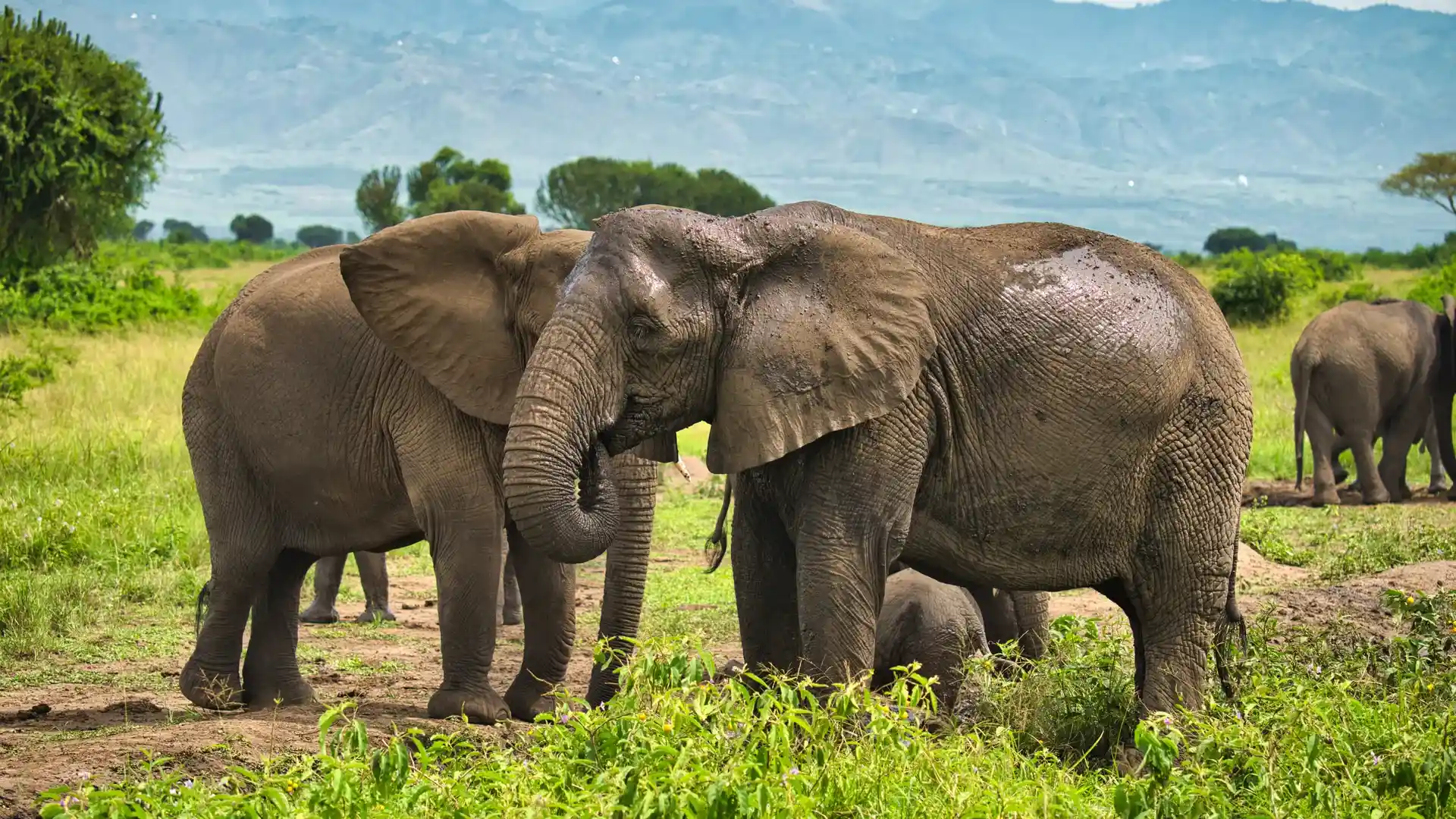
There is something about seeing elephants in the wild that never gets old. Their size is particularly striking when they walk right past your vehicle or cross the road in front of you.
Murchison Falls National Park and Queen Elizabeth National Park are both excellent places to see them. You may find a few feeding quietly among the trees, or come across a whole herd moving together, with the young ones staying close to their mothers.
You can also observe them beautifully during a boat trip. Particularly along the Kazinga Channel in Queen Elizabeth National Park, you regularly see elephants coming to drink or cool off at the water’s edge. Watching them from the boat gives you a lovely opportunity to observe them as they go about their daily activities.
Buffalo: Huge herds in Kidepo
You see African buffalos in many national parks, but Kidepo Valley National Park in the north east of Uganda has something special in this respect. Here, the herds can be enormous, so large that it almost looks as if a migration is taking place. Hundreds, sometimes thousands of buffalo scattered across the savannah. From a distance, you see a massive dark mass moving.
However, Kidepo National Park is less predictable in terms of wildlife viewing than, for example, Murchison Falls National Park. The animals here roam a vast area. And they can sometimes be found outside the parts of the park you are visiting. Therefore, you can have a great safari day there, but on another day, you may see fewer animals than you hoped for. In our opinion, Kidepo remains worthwhile, if only for the impressive landscape and quiet atmosphere make.
Rhinos: a remarkable story of return
Rhinos vanished from the wild in Uganda in 1980s, due to poaching and years of political unrest, among other factors. For a long time, Ziwa Rhino Sanctuary was the only place in Uganda where you could see these animals. Since then, efforts have also been made to brink rhinos back to areas such as Kidepo Valley National Park and Ajai Wildlife Reserve.
For now, Ziwa remains the most logical place to see rhinos during a Uganda safari. Here, you set out in search of the animals on foot with an experienced ranger guide. This makes for a very different kind of experience from a game drive. You get to observe the rhinos from relatively close up while learning about the efforts to protect them and restore their population in Uganda.
Another advantage is Ziwa’s location along the main from Kampala to Murchison Falls National Park. This makes it easy to include rhino tracking in your itinerary without having to make a major detour. You can read more about their history and conservation in our blog about rhinos in Uganda.
Zebras, giraffes, and other special savannah animals
Apart from the Big Five, there are many more animals that make a Uganda safari special.
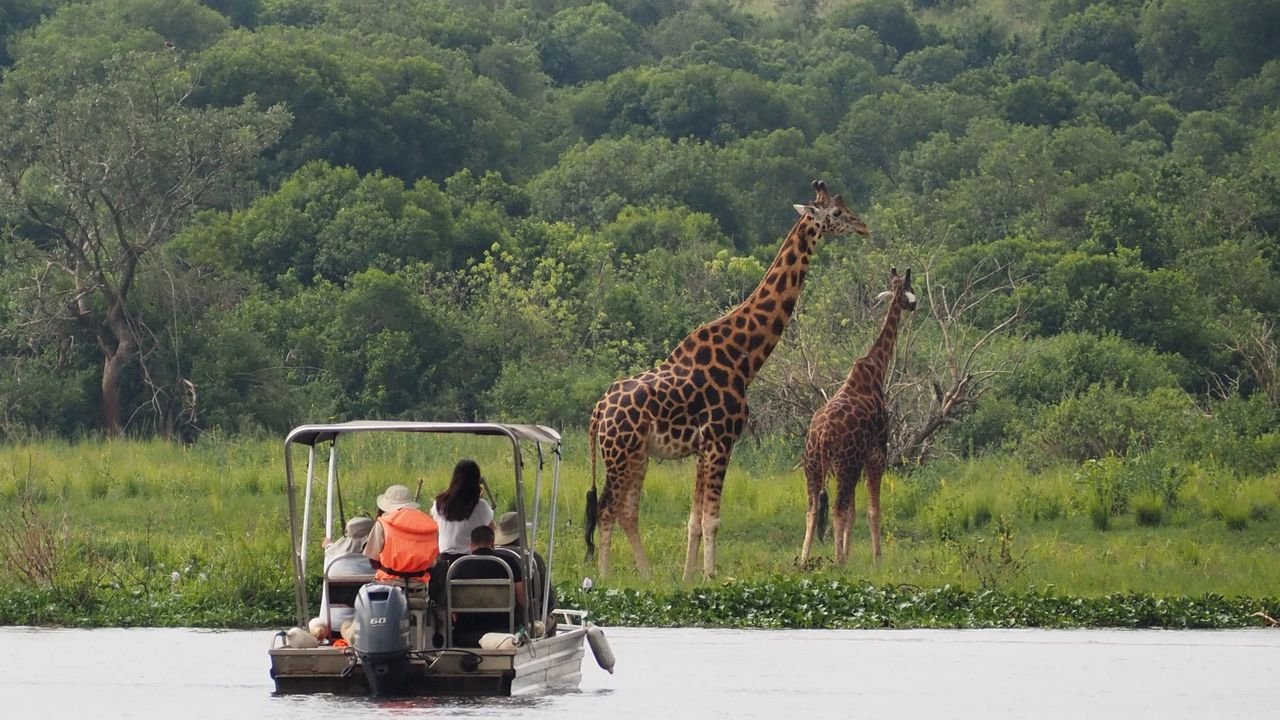
Giraffes: in Lake Mburo National Park can even be admired on foot
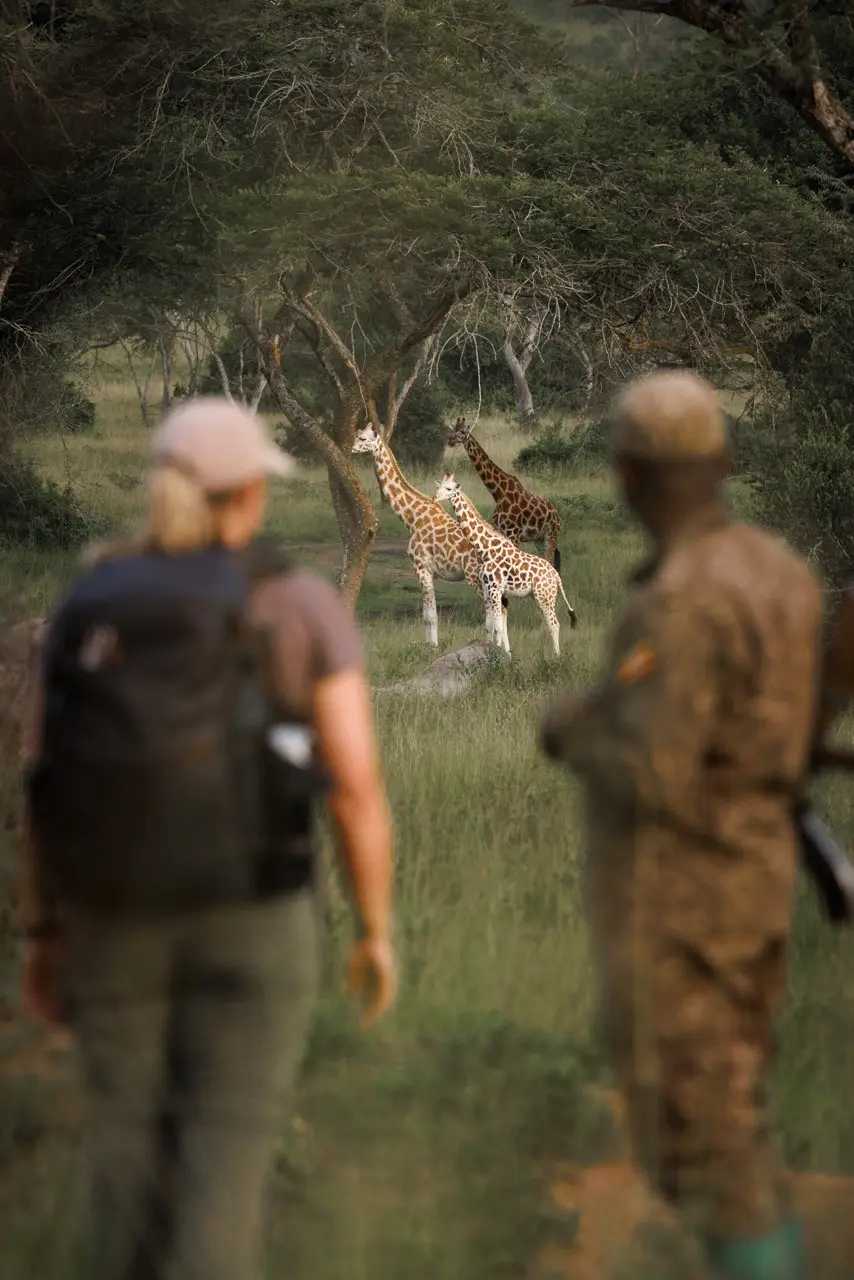
In Uganda, you see giraffes mainly in Murchison Falls National Park and Lake Mburo National Park. In Murchison Falls National Park, you often see them during nature game drives, sometimes standing alone among the trees and sometimes in groups.
But an experience that we personally find particularly beautiful is the game walk in Lake Mburo National Park. Accompanied by a ranger, you set out on foot to look for giraffes, zebras, antelopes and other wildlife. You can sometimes get surprisingly close to these animals while still keeping a safe distance. Seeing a giraffe from a vehicle is one thing, but standing on the ground just a short distance away gives you a completely different impression of its size. When you look up at such a tall animal, you really appreciate how extraordinary it is. In our opinion, this is one of the most beautiful wildlife experiences in Uganda. Moreover, it is a refreshing change after a few days spent on safari mainly from the car.
Also read our guide on Lake Mburo National Park.
Zebras: mainly in Lake Mburo and Kidepo
In Uganda, you can see zebras mainly in Lake Mburo National Park and Kidepo Valley National Park. Mburo, especially, is an excellent destination for seeing them. It is quite common to find groups of zebras grazing on the plains, often among impalas, topis, other antelopes and giraffes. You can watch them during a game drive, but also get closer to their world on a walking, horseback, or cycling safari.
Another advantage of Lake Mburo is its location. The park lies conveniently along the route between gorilla trekking destinations of southwestern Uganda and Entebbe, making it a natural stop at the end of many of our tours. After exploring the forests and national parks further west, it is a lovely place to spend your final days among the wildlife before returning to Entebbe.

Crocodiles and hippos: the most beautiful from the water
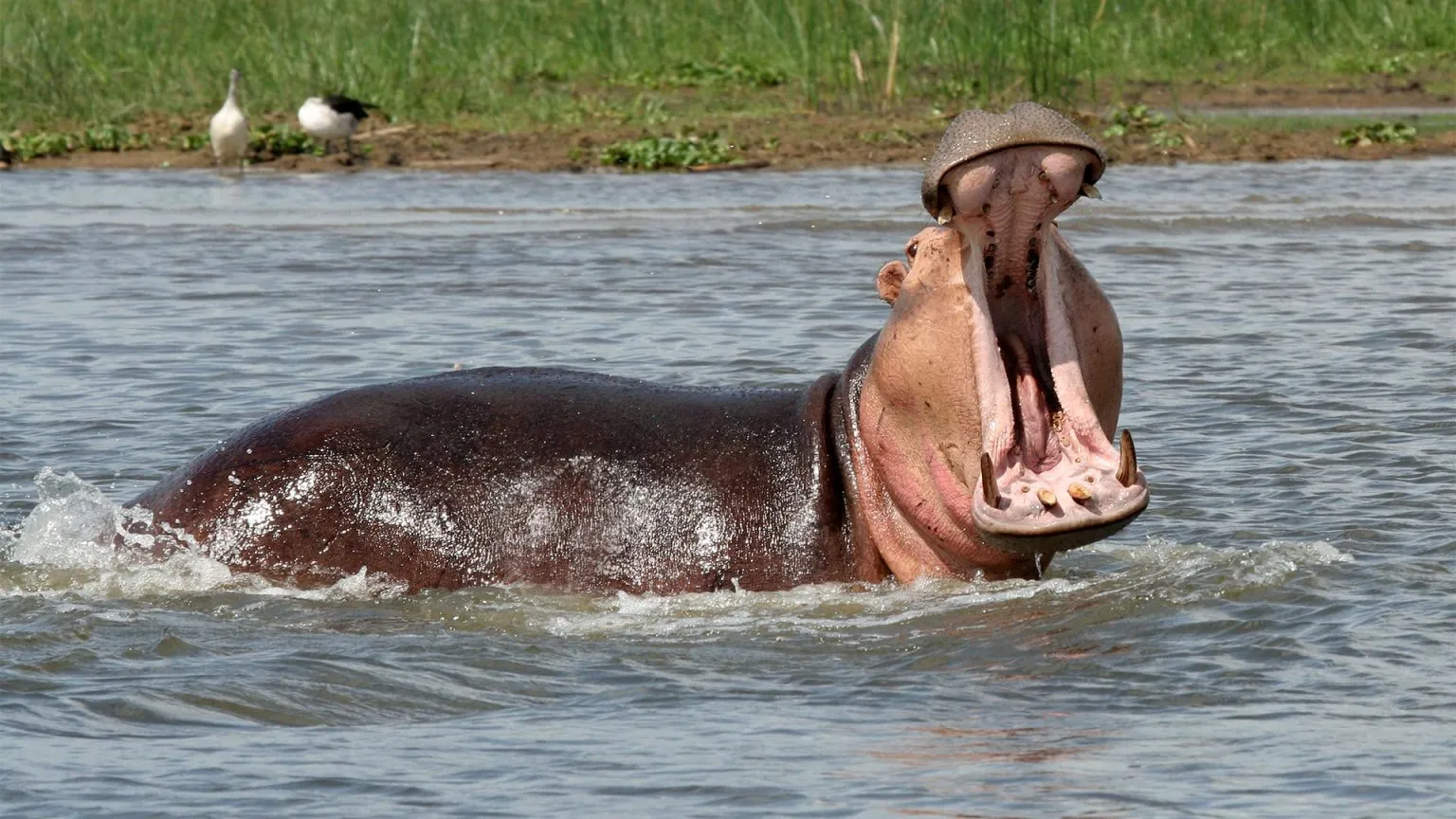
Murchison Falls National Park and Queen Elizabeth National Park are both excellent places to see hippos and crocodiles in the wild. The Kazinga Channel in Queen Elizabeth is particularly famous for its large hippo population.
On boat safari, you see dozens of them resting in the water, with only their eyes and ears showing above the surface. Every now and then, one rises out of the water, opens its enormous mouth or makes its way along the riverbank. Crocodiles are also a common sight, often lying motionless along the banks.
In Murchison Falls National Park, you take a boat trip on the Nile River towards the famous waterfalls. There is plenty to see along the way. Hippos are almost always present, while crocodiles, elephants, buffaloes and many different birds can also be spotted along the river.
In our opinion, a boat safari is one of the most pleasant ways to observe wildlife in Africa. You see animals from a completely different perspective than during a game drive.
Gorillas and chimpanzees: what makes Uganda truly special
What sets Uganda apart from classic Africa safari destinations is the combination of savannah animals and primates. On a single tour in Uganda, you can see elephants, lions, zebras, and giraffes, but also hike into the rainforest in search of chimpanzees and mountain gorillas.
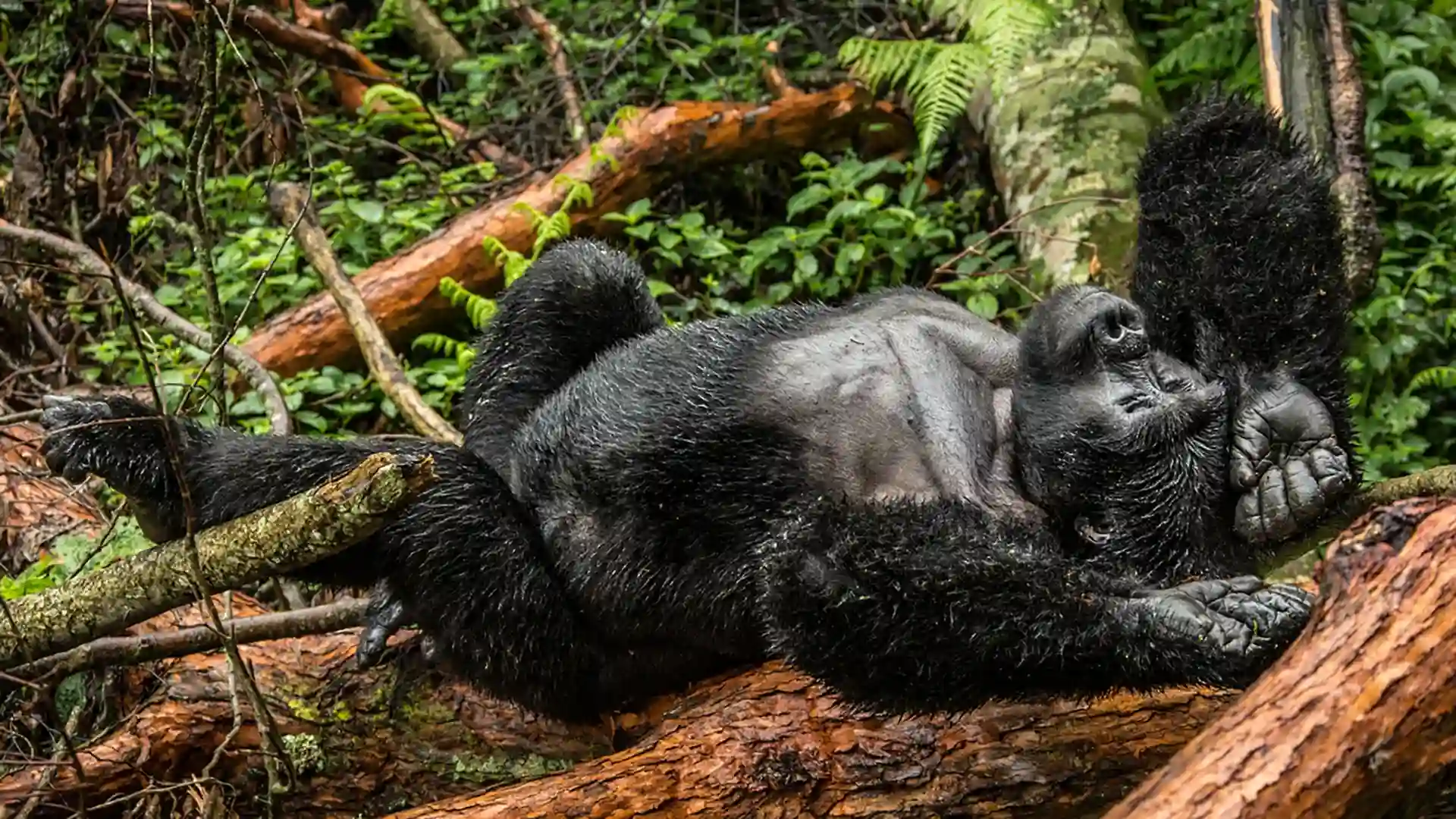
Mountain gorillas in Bwindi and Mgahinga
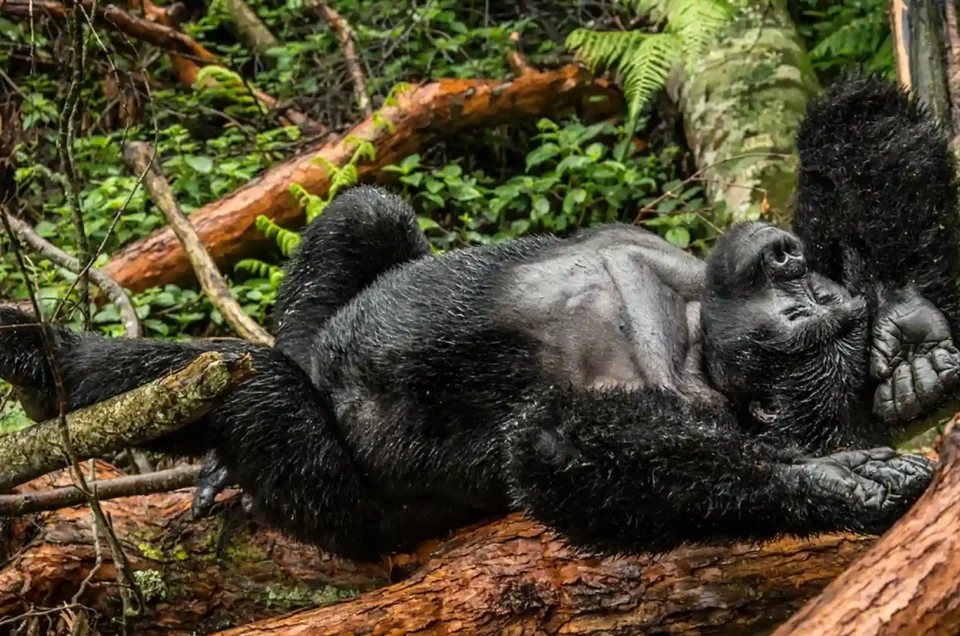
For many travelers, gorilla trekking in Uganda is the absolute highlight of the tour. It is not comparable to a regular safari. You do not drive a car through the animals’ habitat, but instead trek through the rainforest jungle with rangers and trackers. Enroute, you follow narrow trails, climb over tree roots, and sometimes walk through dense green vegetation.
And then, suddenly, you find yourself face to face with a family of gorillas. Perhaps you see a baby gorilla playing, a mother with her infant, or a huge silverback quietly keeping an eye on his family. What makes this encounter so special is not only the impressive size of these animals, but above all their behavior. The way they interact with one another, groom each other, and sometimes look at their surroundings with curiosity feels surprisingly familiar.
You won’t be the first to shed a tear during this meeting.
Most gorilla treks in Uganda take place in Bwindi Impenetrable Forest National Park. You can also visit mountain gorillas in Mgahinga Gorilla National Park.

Chimpanzees in Kibale and other forests
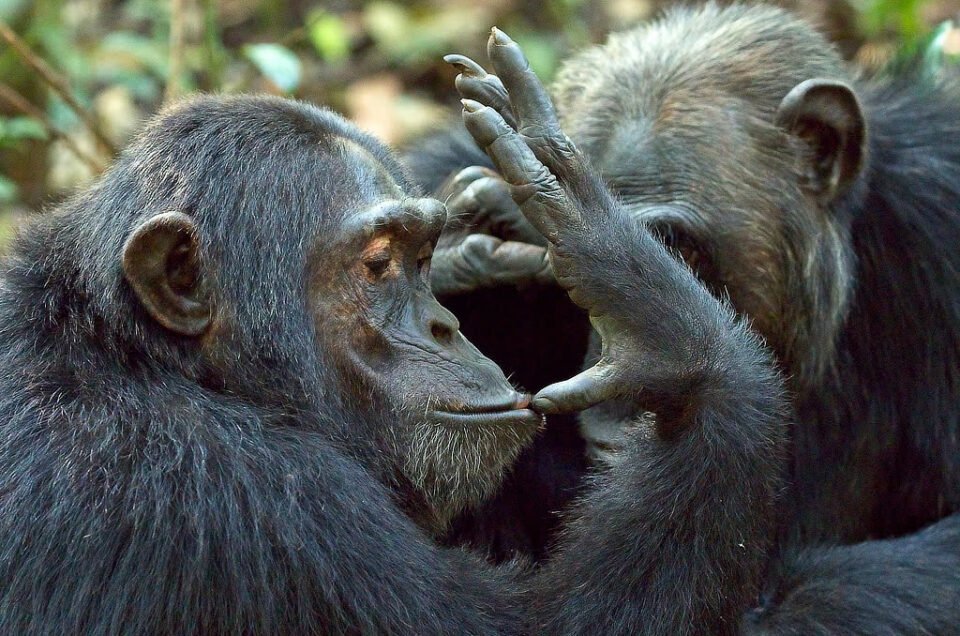
Chimpanzees are every bit captivating as mountain gorillas, but a visit to them is a very different experience. They are more active. They make a lot of noise. And they often move quickly through the trees and across the forest floor. In many ways, they remind us of ourselves. Their facial expressions, gestures and behaviour can look surprisingly familiar.
When you watch them up close, you begin to notice how they communicate, play, argue and look after one another. Sometimes, you even catch them looking back at you.
For chimpanzee trekking, we usually recommend Kibale Forest National Park, which offers some of the best chances of seeing them in Uganda. You can also track chimpanzees in Kyambura Gorge in Queen Elizabeth National Park and Budongo Forest near Murchison Falls. Which location suits best depends on the route and the interests of the travelers.

Golden monkeys in Mgahinga
Another special primate species in Uganda is the golden monkey. These small, beautifully colored monkeys live in the Virunga Volcanoes, in the far southwest of Uganda. They are also active, particularly photogenic, and are generally easy to observe.
A golden monkey trek is mainly interesting for travelers who enjoy primates, photography, and a relatively strenuous hike. Also, the activity can easily be combined with a stay around Lake Mutanda, Kisoro or Bwindi Impenetrable National Park Rushaga and Nkuringo sectors.

The shoebill: one of the most special Uganda birds
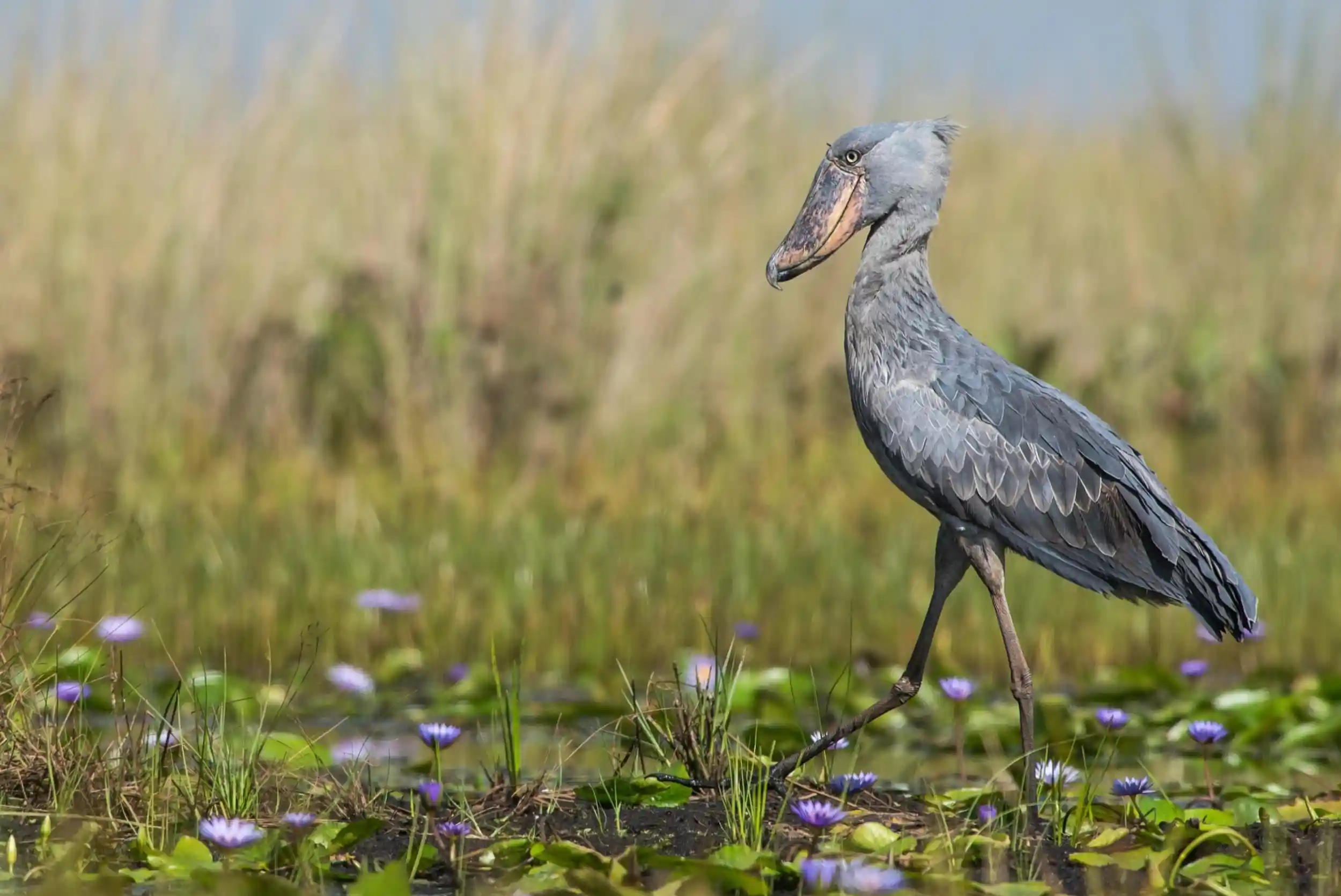
One animal we certainly don’t want to leave out is the shoebill stork. It is a huge prehistoric-looking bird with a massive beak that looks like a shoe. The shoebill can grow to more than a meter tall and is often found standing completely still in the swamp, sometimes for several minutes, waiting patiently for its prey.
If you would like to see a shoebill, we usually recommend Mabamba Wetland on the shores of Lake Victoria, not far from Entebbe. You explore the marsh in a small boat with a local bird guide who knows the waterways and the places where shoebills are regularly found. The guide’s knowledge makes a real difference when looking for this rather elusive bird.
The chances of seeing one in Mabamba are particularly good, and our travellers regularly spot them here. Of course, sightings can never be guaranteed, as shoebills are wild birds. But even before you find one, the boat trip is worth enjoying. You glide through narrow channels surrounded by papyrus, with plenty of other birds to look out for along the way.
Can you also see cheetahs in Uganda?
Yes, cheetahs still live in Kidepo National Park in the Karamoja region, but spotting one during a safari is rare. We would therefore never promise a cheetah sighting or plan an entire Uganda itinerary around the hope of seeing one. If cheetahs are high on your wish list, some parks in Kenya and Tanzania offer much better opportunities.
However, Kidepo has plenty to offer beyond cheetahs. It is one of Africa’s most beautiful national parks, with wide open plains, dramatic mountain scenery and a real sense of being far away from everything. You can still see plenty of other wildlife, including lions, buffaloes, elephants, giraffes and zebras.
Our advice is to visit Kidepo for the whole experience: the landscape, the wildlife, the peace and the feeling of exploring one of Uganda’s most remote corners. The animals you see along the way are part of what makes it special. You can read more about the park in our guide on Kidepo Valley National Park.
How do you combine the best safari parks in one tour?
If you are visiting Uganda for the first time and you would like to see many different animals, will carefully craft an itinerary for you that combines several habitats. A logical itinerary of approximately 12 days to 3 weeks might look something like this:
- Entebbe and Mabamba Swamp: a great start with the shoebill stork.
- Ziwa Rhino & Wildlife Ranch: on the way to Murchison Falls, you go in search of rhinos on foot.
- Murchison Falls: game drives for lions, elephants, leopards, and giraffes, combined with a boat safari.
- Kibale Forest National Park: searching for chimpanzees in the rainforest.
- Queen Elizabeth National Park: savannah game drives and a boat safari on the Kazinga Channel.
- Ishasha Sector and Bwindi Impenetrable Forest: tree climbing lions and then the gorilla trekking.
- Lake Mburo National Park: finish with giraffes, zebras, and a game walk before traveling back to Entebbe.
This is not a fixed route that works best for everyone.
Sometimes we may opt to stay longer in a particular park, leave out a destination, or add Kidepo National Park. Kidepo is located far to the northeast of Uganda and requires quite a bit of extra travel time. Therefore, we recommend this park primarily if you have sufficient time (around 18 days and 3 weeks) and consciously choose the remote location, the landscapes, and the tranquility.
What we consider most important is that you have sufficient time to see animals. We prefer two good game drives and a beautiful boat safari to traveling from park to park at a high pace.
What is the difference between a safari in Uganda, Kenya, and Tanzania?
Tanzania and Kenya have traditionally been East Africa’s classic safari destinations. They are famous for places such as the Masai Mara and Serengeti, where vast open plains stretch as far as the eye can see and large herds of wildlife roam freely. If you dream of seeing thousands of wildebeest and zebras, or witnessing the annual Great Migration, these two countries are hard to beat.
Uganda offers something quite different. The landscape here is much more varied. You travel from open savanna plains to dense tropical rainforest, from huge lakes to volcanic mountain landscapes. So, you experience nature in many different ways.
In Tanzania and Kenya, a classic safari often revolves largely around nature game drives from the vehicle. In Uganda, you can combine this with mountain gorilla trekking, chimpanzee trekking, walks among giraffes and Zebras, boat safaris, and active treks through the mountains.
The level of crowding is another difference. During the busy season, some of the best-known parks in Kenya and Tanzania can attract large numbers of safari vehicles, particularly around popular wildlife sightings. In Uganda, tourism is generally on a smaller scale, and you can still find places where you spend much of the day without seeing many other visitors. That does not mean you are alone everywhere. You may also run into other visitors during popular activities such as gorilla trekking or game drive in popular game parks. However, the sense of peace and space is often very different in Uganda.
So, which country should you choose? We do not believe that Uganda is by definition a better safari destination than Kenya or Tanzania. It really depends on what you want from your African safari. If your main dream is to spend several days on classic game drives across vast savannah plains, Kenya and Tanzania are excellent choices.
But if you want to combine traditional wildlife safaris with gorilla trekking, chimpanzee tracking, walking safaris and very different landscapes, Uganda offers a wonderful mix that you will find in few other places.
What is the best time to travel to see animals in Uganda?
In Uganda, you can see wild animals at any time of the year.
The dry season, roughly from December to February and from June to August, are often pleasant for game drives and walks. The roads and trails are generally more passable during these times.
But you can also go on beautiful safaris during the rainy season. The landscape is often particularly, green and beautiful then. And there are usually fewer travelers. Also, mountain gorillas and chimpanzees can be visited all year round. Rain can make the trek more difficult, but it does not automatically mean you have less chance of seeing the animals.
The best time to visit therefore also depends on the route, the activities you want to undertake, and your personal preferences.
Spotting animals in Uganda: our top tip
As you can see, Uganda is home to an incredible variety of wildlife. Don’t just try to tick off as many animals as possible. Of course, it is fantastic when you see the entire Big 5 during your tour. And we completely understand that you would love to encounter a leopard, lion, or gorilla. But some of the most beautiful moments arise exactly when you take your time.
A family of elephants peacefully crossing the road. A herd of giraffes that you can observe up close during a walking safari. Hundreds of buffaloes wandering the landscape of Kidepo Valley. Or a leopard that suddenly appears after a long search. That is why we work with knowledgeable guides who not only know where to find animals but also understand when it is worthwhile to stay somewhere a little longer.
At Greenway Nature Tours, we organize fully customized private tours. We are happy to help you determine which parks and activities best suit the animals you want to see, without you having to be constantly on the move. Curious what such a trip might look like? Feel free to contact us. We will then create a free proposal that fits your wishes and budget.
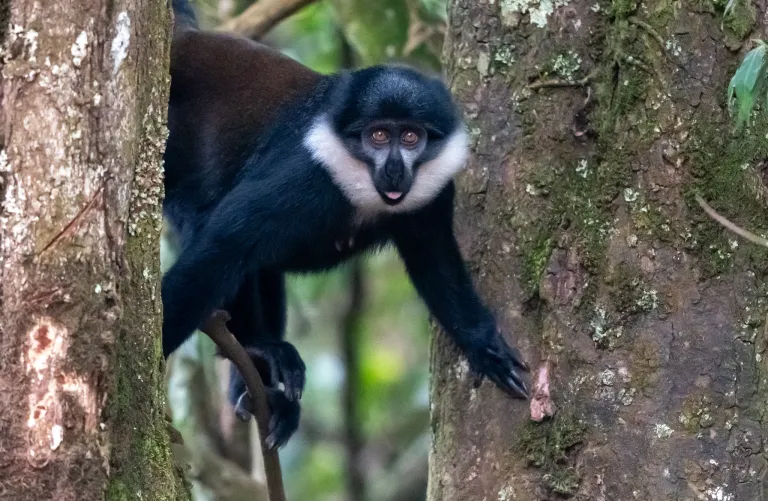
You might also be interested in these articles:
Greenway nature tours
We are a fully licensed tour company accredited by the Uganda Tourism Board. We design and operate safaris in Uganda and East Africa. Our operations are based in Kampala, Uganda, the heart of our safari planning and coordination. Though our company was officially established in 2025, our team brings deep, hands-on knowledge of East Africa.
Destinations
Favourite Tours
Help & Info
- About us
- Travel Blog
- Travel FAQS
- Gorilla Permits Bookings
- Contact Us
- Pay Online