Chimpanzees in Uganda: where can you see them and how much does a trek cost?
Coming face-to-face with chimpanzees in the wild is one of the most special wildlife experiences during a safari in Uganda. But where is the best place to see chimpanzees in Uganda: Kibale Forest, Kyambura Gorge, Budongo Forest, Bugoma Forest, or Kalinzu Forest? We explain how chimpanzee trekkking works, what to expect, and which place we recommend based on our experience in Uganda.

What makes chimpanzees Viewing so special?
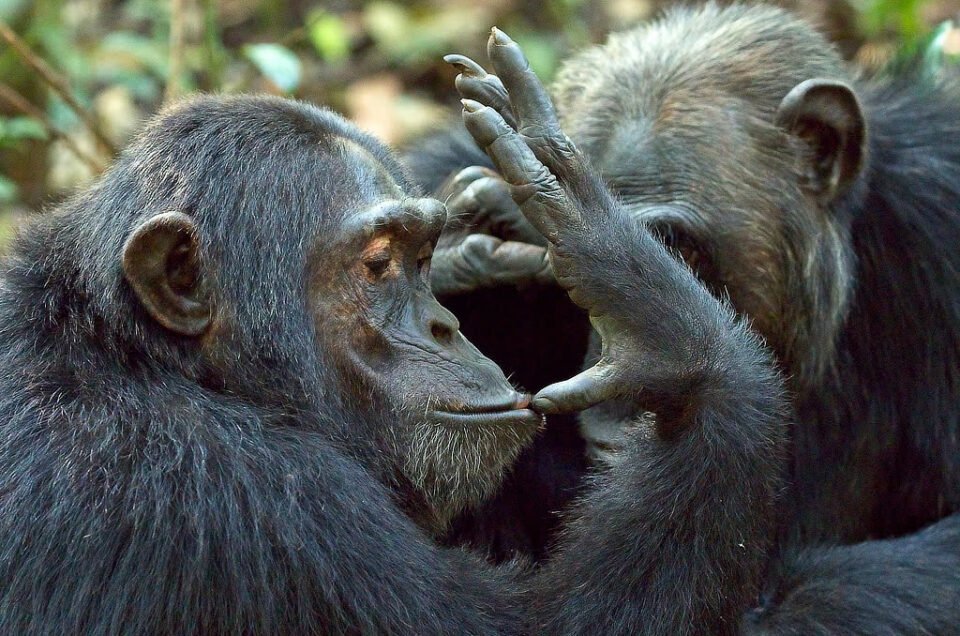
Chimpanzees are our closest living relatives. And they look a great deal like us: in terms of facial features, body size, and the way they move. You can see a lot of emotion in their faces. When you come face to face with them, you feel a striking kinship. You observe how intelligent they are, how they communicate with each other, play, groom each other, and sometimes fight.
An encounter with chimps is often much livelier than a mountain gorilla trek. While gorillas tend to spend long periods sitting quietly and feeding, chimpanzees are usually on the move. You can sometimes hear their loud calls from a great distance. And if the group decides to move through the forest, you may very well find yourself doing quite a bit of walking too. It is exactly this unpredictability that makes the chimpanzee trekking experience special.
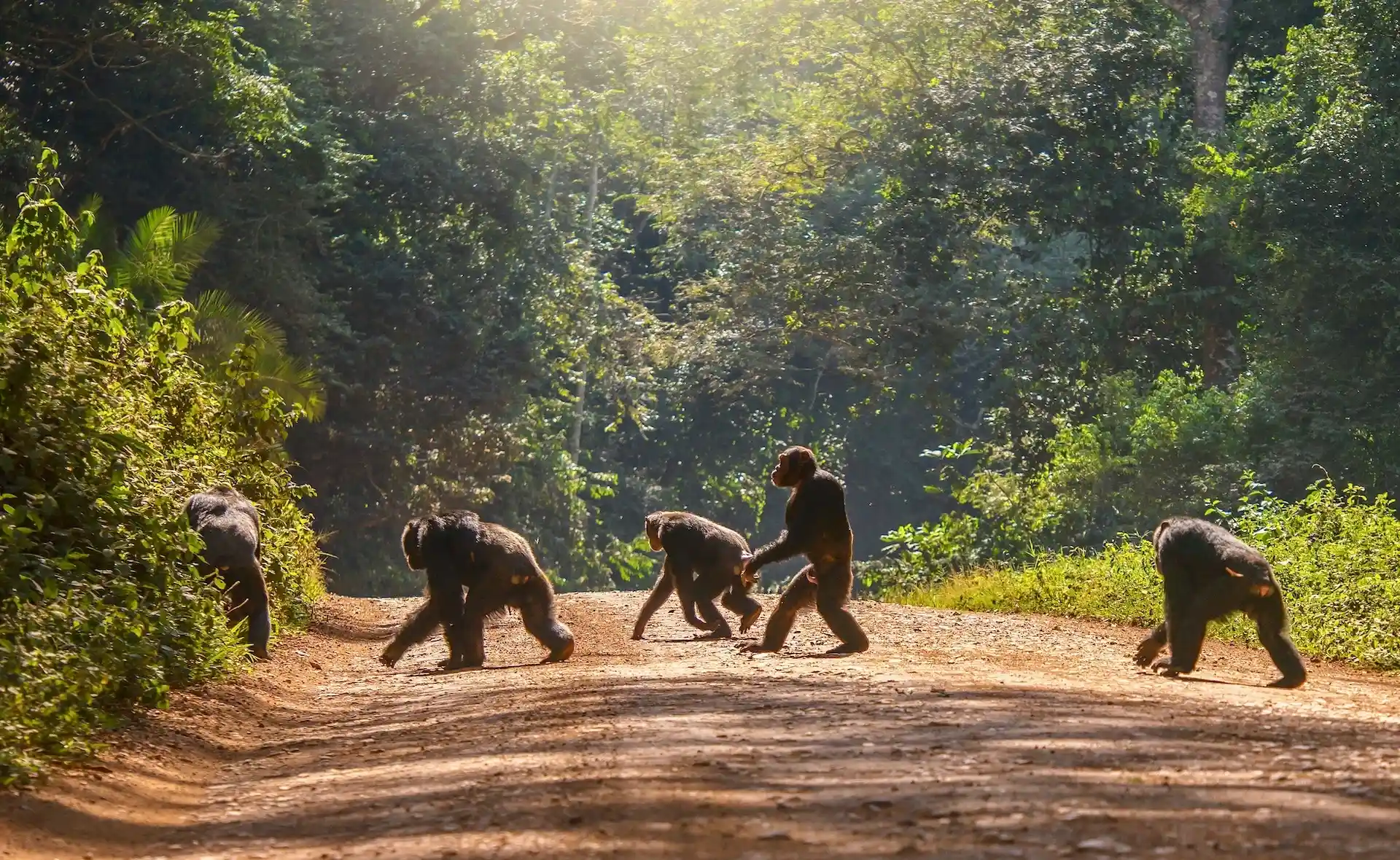
Where in Uganda can you visit chimpanzees?
The best-known place to see chimpanzees in Uganda is Kibale Forest National Park. However, Kyambura Gorge in Queen Elizabeth National Park, Bugoma Forest, Budongo Forest, and Kalinzu Forest also offer chimpanzee trekking. In the previous version of this article, we said the alternatives primarily as cheaper and quieter. That is too simplistic.
The choice depends just as much on your safari route; the kind of forest walk you are looking for and what else you want to do during your trip. We usually recommend Kibale Forest or Kyambura Gorge to our travelers. Budongo Forest and Bugoma Forests are particularly interesting if Murchison Falls National Park is already part of your safari itinerary and you have limited time.
Kalinzu Forest Reserve can also be an alternative for travellers visiting Queen Elizabeth National Park, although we do not include it as a standard stop in our Uganda safari tours.
Kibale National Park: our first choice for many tours
Kibale National Park in western Uganda is the most famous place in the country for chimpanzee trekking. Around 1500 chimpanzees live in it’s tropical rainforest, and the rangers track the different communities daily. As a result, the chances of seeing chimpanzees here are usually high. The trek is generally manageable for travelers with an average level of fitness, although muddy trails and moving chimpanzees can sometimes make it more challenging.
What makes Kibale National Park particularly special to us is the surrounding area. We know the various activities and communities around the park well. You don’t come here just for the chimpanzees. The crater lakes, the Bigodi Wetland Sanctuary, and the green rolling hills are also reasons to stay a little longer. That is why we generally recommend spending at least three nights in the area.
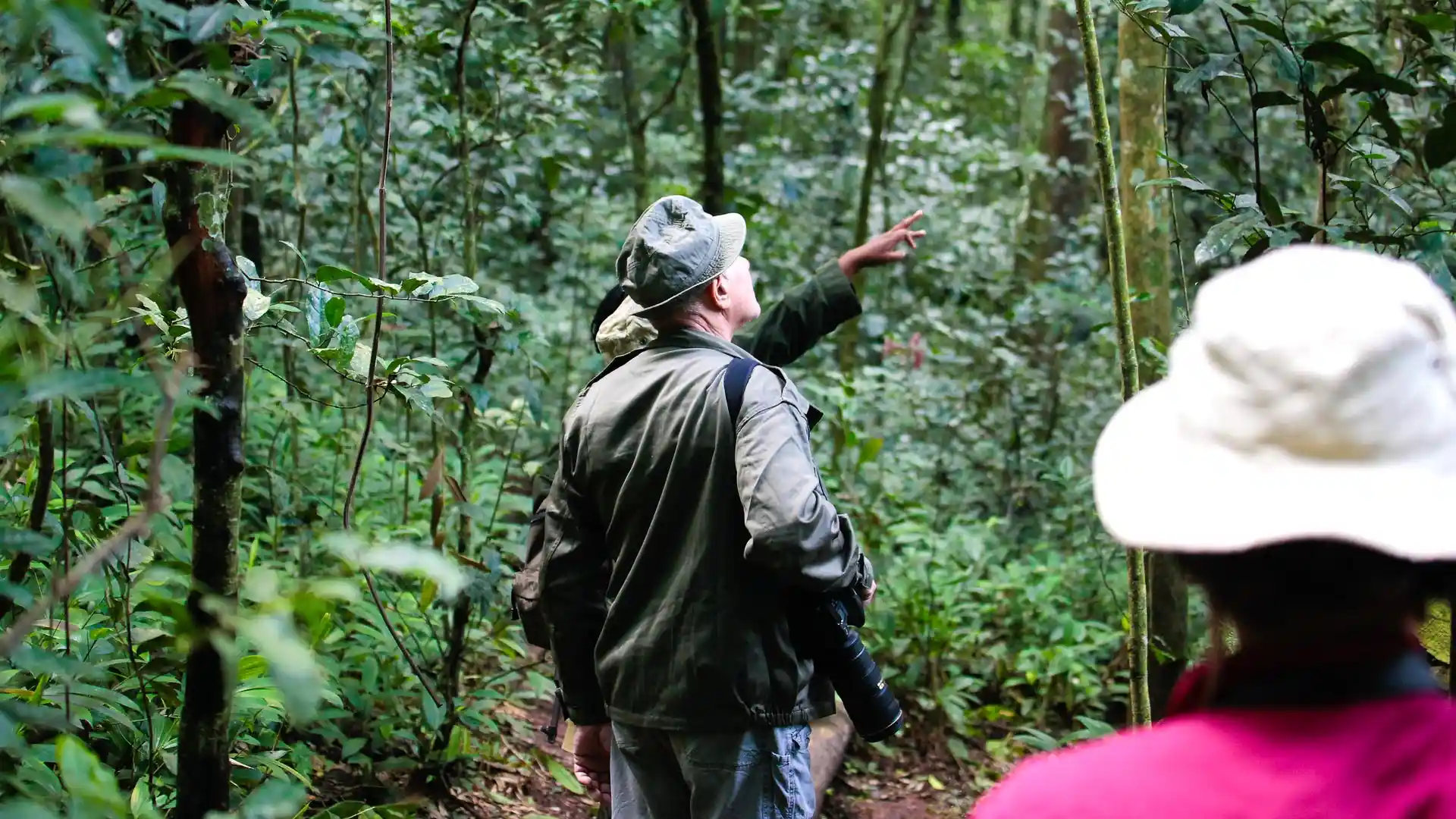
Kyambura Gorge: a special trek in the middle of the savannah
Kyambura Gorge lies within Queen Elizabeth National Park in southwestern Uganda. From the savannah, you descend about 100 meters into a tropical gorge with a river flowing through it. You cross the water at several points using simple bridges, and you may even spot hippos along the way. The contrast between the open savannah grassland above and the rainforest on the floor of the gorge makes this trek special in itself.
From our own experience, the chimpanzee population in Kyambura Gorge has grown in recent years. We have also noticed a significant improvement in the chances of seeing them. We now consider Kyambura Gorge as a serious alternative to Kibale Forest National Park, particularly for travelers already staying at Queen Elizabeth National Park and would rather enjoy an active outing rather than an extra game drive. However, the trek is physically more demanding than a typical chimpanzee trek in Kibale Forest. The descent into the gorge and the climb back up require a reasonable level of fitness.
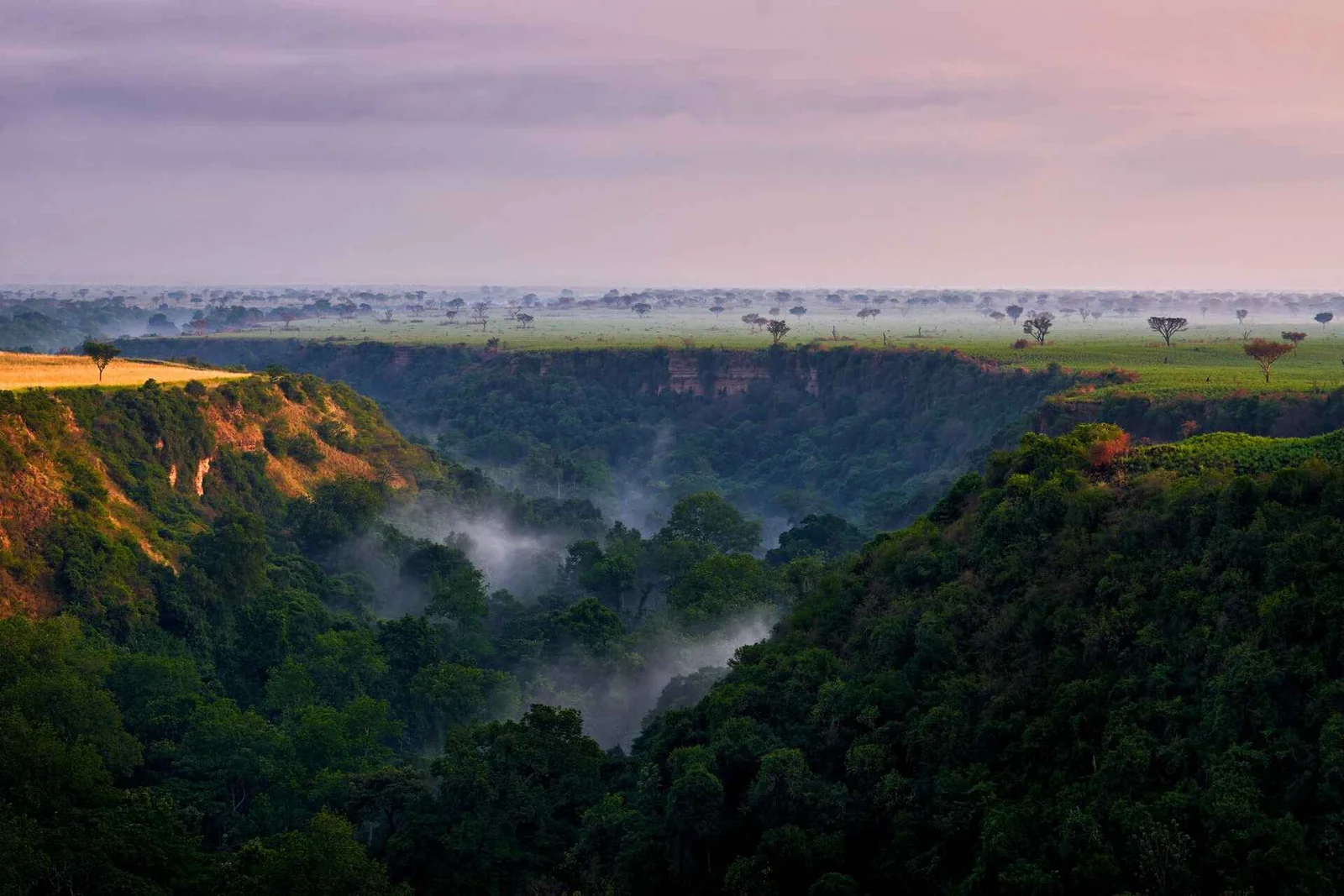
Budongo Forest: a practical choice at Murchison Falls
Budongo Central Forest Reserve is located in the southern section of Murchison Falls National Park in northwestern Uganda. It is known, among other things, for its enormous mahogany trees. Chimpanzee trekking here can be a good option on a short tour of northwestern Uganda. You then do not have to travel specifically to Kibale Forest just to see chimpanzees.
If the route allows, we generally prefer Kibale Forest National Park or Kyambura Gorge. However, for travellers with limited time who are already visiting Murchison Falls National Park, Budongo is a logical choice. The terrain is generally less steep than in Kyambura Gorge, although you never know in advance how far you will have to walk.
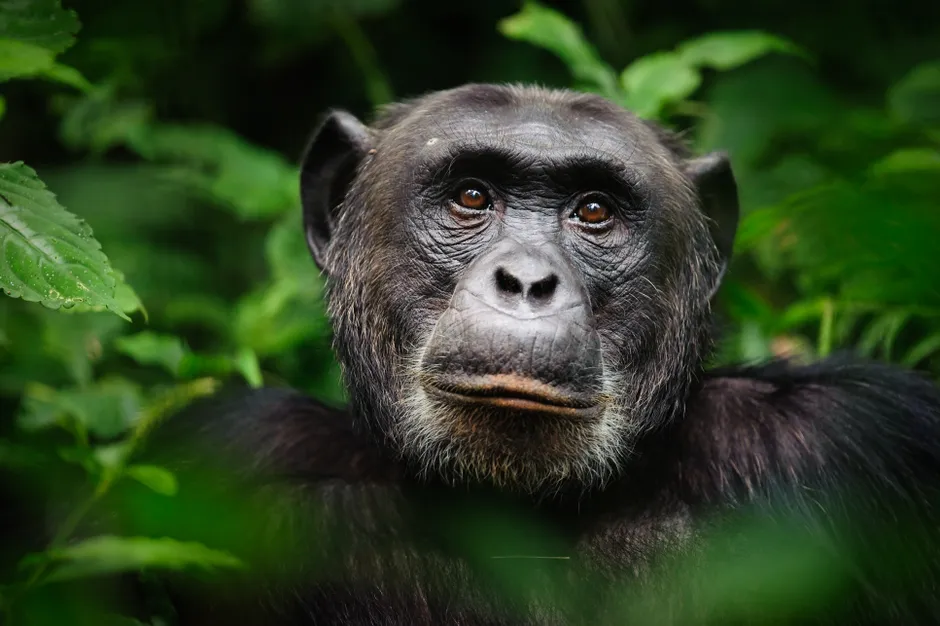
Kalinzu Forest: an alternative at Queen Elizabeth.
Kalinzu Forest Reserve is also located near Queen Elizabeth National Park in southwestern Uganda. You can go on a guided trek here to see some of the estimated 300 chimpanzees living in a forest. The reserve is also home to several other monkey species and a wide variety of birds. We do not include Kalinzu Forest as standard in our Uganda safaris and tours. However, depending on your itinerary and the availability of permits, it can be a good alternative.
Bugoma Forest: An Off-the-Beaten-Track Chimpanzee Trek
Bugoma Forest is Uganda’s newer and less-visited places for chimpanzee trekking. Although it was established in 1932, it has received relatively little attention as a tourism destination. The forest lies between Murchison Falls National Park and the Semliki Valley and is home to many forest primates and birds, including an estimated 550 chimpanzees.
We find Bugoma particularly interesting because of its conservation history. In recent years, it has been a battleground between developers wanting to clear it for sugarcane plantations and environmental campaigners opposed to this. For anyone familiar with this aspect of the forest’s history, it is heartening to learn that Bugoma opened as a chimpanzee trekking site in 2024. We also see Bugoma as a practical option for travellers going from Murchison Falls to Kibale Forest.
Kibale or Budongo: where is it better to see chimpanzees in Uganda?
If chimpanzees are an important part of your Uganda safari, we usually recommend Kibale Forest National Park. The large population of chimps, the generally high chance of seeing them, and the diverse environment make it a strong choice.
Budongo Forest is especially interesting if you are visiting Murchison Falls National Park and a detour to Kibale National Park does not fit well into your itinerary. Also remember the Kyambura Gorge in that consideration. If you are an active travelers on a wildlife safari in Queen Elizabeth National Park, a hike through Kyambura Gorge can even be the most attractive experience.
The locations in brief
Kibale National Park
Our advice: Kibale is the best all-round choice. There are plenty of things to do in the area.
Terrain: rainforest and often relatively flat.
Kyambura Gorge
Our advice: Kyambura is suitable for active travelers on a safari in Queen Elizabeth National Park.
Terrain: a steep descent and climb in a gorge.
Budongo Forest
Our advice: Budongo is a practical choice for shorter trips via Murchison Falls National Park.
Terrain: forest and generally less steep.
Bugoma Forest
Our advice: Bugoma is a good option for travellers going from Murchison Falls to Kibale who want to include chimpanzee trekking along the way.
Terrain: Tropical rainforest.
Kalinzu Forest
Our advice: Kalinzu is an alternative depending on the availability and your route.
Terrain: forest area.
What does chimpanzee trekking look like?
In Uganda, chimpanzee trekking usually takes place in two sessions. The first starts in the morning at 8:00 am, while the second begins at 2:00 pm. Before setting off, you receive a detailed briefing. The ranger explains what the activity entails and what rules you need to follow. You then enter the forest with a small group accompanied by one or more rangers. How long it takes to find chimpanzees is difficult to predict: after all, they are wild animals. Sometimes you find them within an hour; sometimes the trek can take two or three hours.
Once you find the chimpanzees, you spend a maximum of one hour during the regular trek. You can observe and photograph them. The ranger guides often know the chimpanzee groups inside out. To them, the chimpanzees have names; they recognize the animals, know the dynamics within the group, and can tell you about their age, diet, and behavior. So, you learn a lot while you watch.
What is the chance that you will see chimpanzees in Uganda?
In Kibale Forest National Park, the chance of an encounter is very high. In Kyambura Gorge, we have also noticed a clear improvement in recent years. We deliberately avoid quoting fixed success rates. The chances can vary depending on the location, time of year, the chimpanzee group, and the particular day of your trek. Figures alone also do not tell you what your own experience will be. Chimpanzees move freely through the forest, and an encounter is never guaranteed.
Should You Visit chimpanzees in the morning or afternoon?
In Kibale Forest National Park and several other locations, you can choose between morning and afternoon chimpanzee trekking sessions. Chimpanzees are often more active in the morning, when they are busy feeding and moving through the forest. During the busy tourism season, however, we sometimes recommend the afternoon session. It can be quieter, with fewer other visitors around, which may make the trek more relaxed. When choosing the best session, we also consider your travel schedule, other planned activities and permit availability.
How many nights do we recommend in Kibale?
We usually suggest spending three nights in the Kibale National Park area. Not because the chimpanzee trek takes three days, but because there is much more to see and do in the region. You can, for example, take a walk through the community-run Bigodi Wetland Sanctuary, where you may encounter several other primates and unique birds. The surrounding area is known for beautiful crater lakes. We also enjoy introducing visitors to the local community in the Bigodi Village. This is not about staged performance, but about meeting people and getting a glimpse of everyday life. You might join a relaxed village walk or take part in a local cooking workshop where you roll up your sleeves. And after an active day, you can of course simply relax by your lodge’s pool. By staying in one place a little longer, you don’t have to keep packing your suitcase.
Is chimpanzee trekking suitable for everyone?
Chimpanzee trekking is often less strenuous than mountain gorilla trekking, but do not underestimate the hike. In Kibale Forest National Park, the terrain is fairly flat in many places. However, Kyambura Gorge is a different story: you descend into a forested gorge and have to climb back up afterwards. If you have limited mobility, it would be wise to discuss with us in advance which location suits you best.
Is a chimpanzee trek suitable for children?
The minimum ages for chimpanzee trekking in Uganda vary by location and operator. For Budongo Forest Reserve, a minimum age of 15 applies according to the 2026–2027 rate conditions. For Kibale National Park, Kyambura Gorge, and Kalinzu Forest, we check the current conditions before booking a trek for a family vacation. If the children are still too young, there are plenty of other activities in the Kibale area, such as a walk through Bigodi Wetland.
What do you bring on a chimpanzee trekking tour?
There are so many tips, but these are the most important:
- Good hiking shoes or sturdy sports shoes with enough grip, especially on muddy paths.
- Long, comfortable trousers. You really don’t need an Indiana Jones outfit.
- Long socks that you can pull over your trouser legs to keep insects and safari ants out. Safari ants can give you a nasty bite, although they are not poisonous.
- Insect repellent and sunscreen. You can still get sunburned in the rainforest.
- A light rain jacket. Tropical showers can occur at any time.
- Enough drinking water and perhaps a small snack for before or after the trek. Eating near the chimpanzees is not allowed.
- A walking stick if you need extra support on uneven ground.
- A camera without flash for taking photographs without disturbing the chimpanzees.
Always follow your ranger guides’ instructions during the encounter and keep enough distance from chimpanzees. If you are sick or have flu, please report this in advance: chimpanzees share almost 99% of our DNA and are susceptible to human infections.
How much does chimpanzee trekking in Uganda cost?
The price of the chimpanzee trekking varies by location and may change per travel year. The amounts below are the rates known to us or indications for foreign non-residents in 2026 and 2027; for travel from 2028 onwards, we will re-check the applicable rates.
Rate Per Location
Kibale National Park
- Amount per person for 2026: US$ 250
- Amount per person for 2027: US$ 300
Kyambura Gorge
- Amount per person for 2026: US$ 100
- Amount per person for 2027: US$ 200
Note: excluding entrance fee to Queen Elizabeth National Park.
Budongo Forest – low season
- Amount per person: US$ 120
Note: valid from June 1, 2026 through December 2027; excluding park entrance fee.
Budongo Forest – high season
- Amount per person: US$ 130
Note: valid from June 1, 2026 through December 2027; excluding park entrance fee.
Kalinzu Forest
- Amount per person: US$ 130
Bugoma Forest
- Amount per person: US$ 80
Budongo, Kalinzu and Kibale Forest rates include entrance fees. At Kyambura Gorge, in addition to the chimpanzee trekking permit, you pay the regular entrance fee of US$40 for Queen Elizabeth National Park. If you are already staying there, Kyambura can be financially attractive. However, a lower permit price does not automatically mean the entire tour will be cheaper: the route and any extra overnight stays also count.
What is the difference between a regular chimpanzee trek and chimpanzee habituation?
On a regular chimpanzee trek, you visit chimpanzees used to the presence of humans and are allowed to stay with them for a maximum of one hour. During a chimpanzee habituation experience, you go out for a longer period with a specialized team and gain more insight into the process of how chimpanzees gradually get accustomed to human presence.
The chimpanzee habituation experience is more expensive and exclusive, but not automatically more beautiful. The chimps can be even shyer and keep more distance, making it sometimes more difficult to observe or photograph them.
If you are primarily seeking a special encounter, we usually advise that you go for a standard trek. If you are mainly interested in behavior, research, and conservation, habituation can be an interesting choice. Availability and conditions vary by location.
Make a chimpanzee trek part of your Uganda safari
Chimpanzee trekking is special. But in our opinion, the experience is even better if it is a logical part of your trip through Uganda, rather than an activity that is simply squeezed into the itinerary. Perhaps Kibale Forest National Park fits perfectly into your route. Perhaps Kyambura Gorge or Budongo Forest Reserve would be a smarter choice. That depends on where you want to go next, how much time you have, and what type of trek suits you.
At Greenway Nature Tours, we therefore always look at the trip as a whole. How do the different places follow one another? Where do you want to stay a little longer? When is it nice to be active, and when would you prefer to do nothing at all? And how do we combine the chimpanzees with safaris, mountain gorillas, beautiful lodges, or other experiences that are important to you?
We are Ugandans with professional experience in tourism and know the routes, distances, and various possibilities from practical experience. We would be happy to help you turn this into one smooth-running tour. You can get in touch with us to discuss your travel wishes.
You might also be interested in these articles:
Greenway nature tours
We are a fully licensed tour company accredited by the Uganda Tourism Board. We design and operate safaris in Uganda and East Africa. Our operations are based in Kampala, Uganda, the heart of our safari planning and coordination. Though our company was officially established in 2025, our team brings deep, hands-on knowledge of East Africa.
Destinations
Favourite Tours
Help & Info
- About us
- Travel Blog
- Travel FAQS
- Gorilla Permits Bookings
- Contact Us
- Pay Online