Travel Rwanda
The land of a thousand hills, jungles, and gorillas
Rwanda Destinations Map
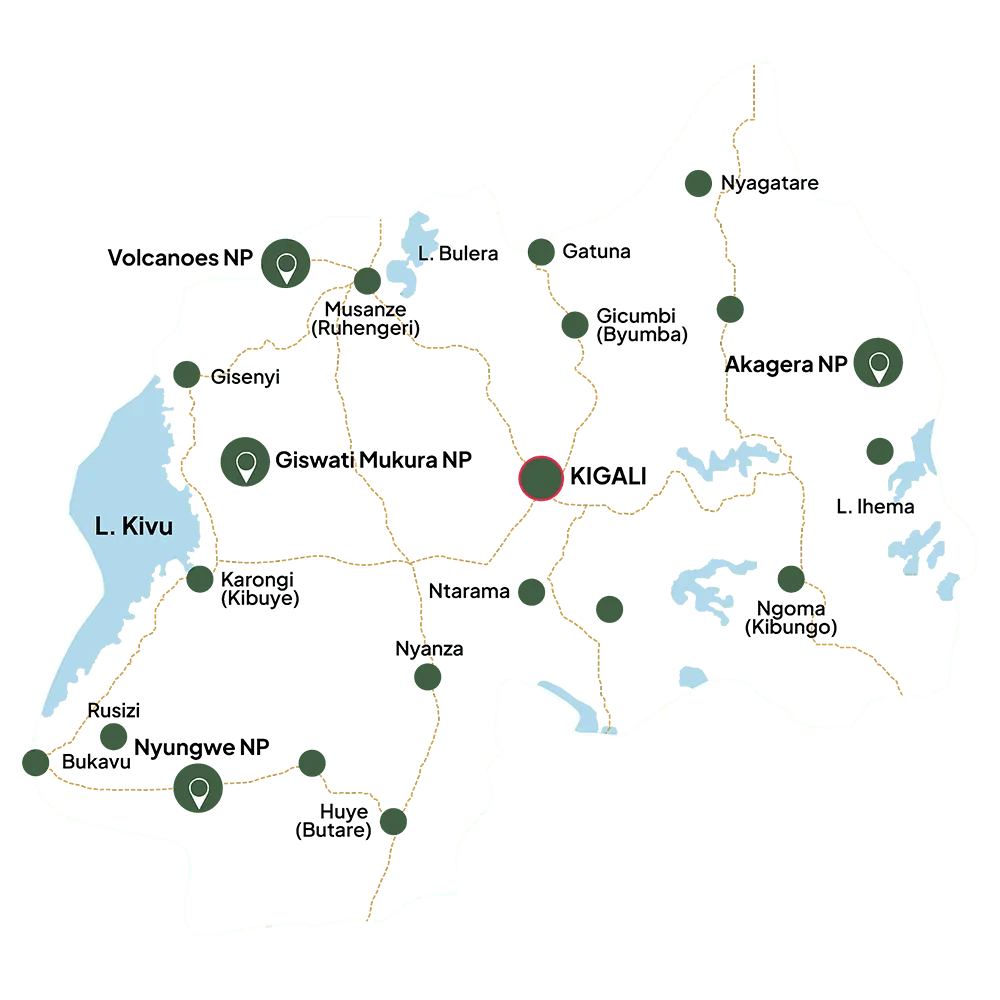
Rwanda At A Glance
- Location: East Africa, 2° south of the equator
- Time Zone: GMT +2
- Capital city: Kigali
- Airport: Kigali International Airport (KGL)
- Size: 26,338 km² (roughly the size of Belgium)
- Altitude: 1,000–4,416 m above sea level
- Climate: Mild and pleasant year-round, 15–28°C
- Best time to visit: Jun-Sep (long dry), Dec–Feb (short dry), although gorilla trekking is available year-round
- Currency: Rwandan franc (Rwf) · US dollars accepted
- Visas: On arrival, free for AU, Commonwealth & La Francophonie members
- Yellow fever vax: not required, proof needed if arriving from a yellow fever country
- Malaria risk: Yes, prophylaxis advised
- Key wildlife: Mountain gorillas, chimps, Big 5
- Top parks: Volcanoes NP, Nyungwe NP, Akagera NP
- Gorilla trekking permit cost: US$1,500 per person per trek
- Pairs well with: Uganda, Tanzania, Kenya, Zanzibar
Safari in Rwanda
The ‘Land of a Thousand Hills’, Rwanda, is a specail destination for safari enthusiasts. This Central East African country has recovered miraculously since the horrific 1994 genocide. Today, Rwanda is a stable, safe, and welcoming country, full of natural beauty and rich culture. Thanks to the relatively short travel distances and well-maintained roads, you can fully enjoy the colorful daily life and the impressive landscape.
Gorilla and Chimpanzee trekking in Rwanda
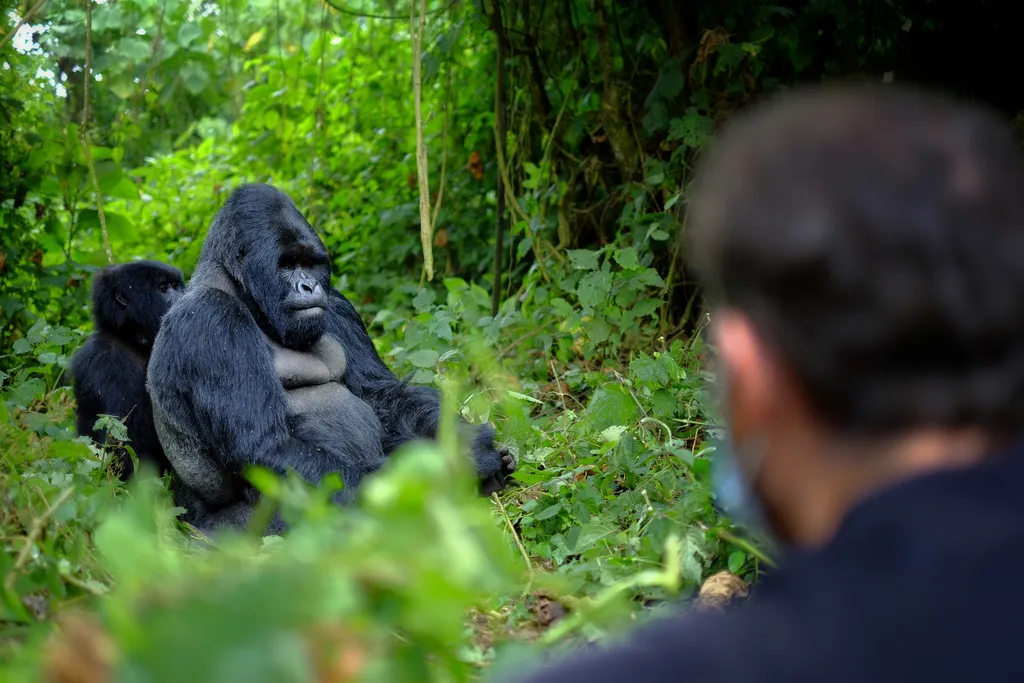
One of the biggest attractions in Rwanda is an encounter with mountain gorillas during gorilla trekking in Volcanoes National Park. Here, located in the magnificent Virunga volcanoes, you can see these impressive primates in their natural habitat. For many travelers, this is the absolute highlight of their safari in Rwanda. But, Rwanda has much more to offer. In the southwest lies Nyungwe Forest National Park, a tropical rainforest jungle that is a paradise for bird lovers and primate enthusiasts. Here, you can spot wild chimpanzees and many bird species during chimpanzee treks. Contact us for the extensive options and availability.
Big Five and nature
Akagera National Park in eastern Rwanda, offers a classic safari adventure with vast savannas and the opportunity to see the Big Five animals of Africa. It is a totally different landscape and offers a unique experience from the rest of the country. Lake Kivu, located between Rwanda and the Democratic Republic of Congo, is a popular destination for relaxation. The clear water and surrounding hills provide a beautiful backdrop to unwind after a safari.
A hospitable country with a rich culture
Rwanda is known for its warm hospitality and colorful culture. As you tour the country, you will see local markets, tea plantations, and small villages that bring Rwanda to life. The rolling landscape with green hills makes the tour extra special. Traveling through Rwanda offers more than just nature. It gives you the chance to learn more about the history and resilience of the Rwandans. Rwanda is Greenway Nature Tours destination that has something to offer everyone, from nature lovers to culture seekers.
Where To Go on A Safari In rwanda?
Rwanda hosts three exceptional national parks and a thriving capital. Here are the top destinations to include in your Rwanda safari:
best Rwanda Safari Packages
All can be customized
Frequently Asked Questions
A safari to Rwanda is not something you take lightly. It is a special destination, and that requires an organization that truly suits you. To help with that choice, we have already answered the most frequently asked questions for you below.
When is the best time to visit Rwanda?
Rwanda is a fantastic destination year-round. Thanks to its high altitude and location just south of the equator, temperatures remain pleasant throughout the year, usually ranging between 15°C and 28°C.
However, the dry seasons are generally considered the best times to visit.
June to mid-September is the main dry season and the most popular time to travel. Trails are drier, gorilla and chimp trekking is more comfortable, and wildlife is often easier to spot in Akagera National Park.
December to February is the shorter dry season. Conditions are excellent for trekking, the weather is pleasant, and visitor numbers are often lower than during the peak months of June to September.
March to May brings the long rainy season. The forests become incredibly green and beautiful, but trails can be muddy and more challenging. Gorilla and chimp trekking still take place, and the parks are generally quieter.
October and November form the short rainy season. Expect occasional showers, lush scenery, and excellent birdwatching opportunities.
One important thing to remember: gorilla permits are limited and highly sought after. If you plan to travel during the most popular months, it is wise to book well in advance, sometimes a year or more ahead.
What wildlife will I see in Rwanda?
For such a small country, Rwanda offers an impressive variety of wildlife.
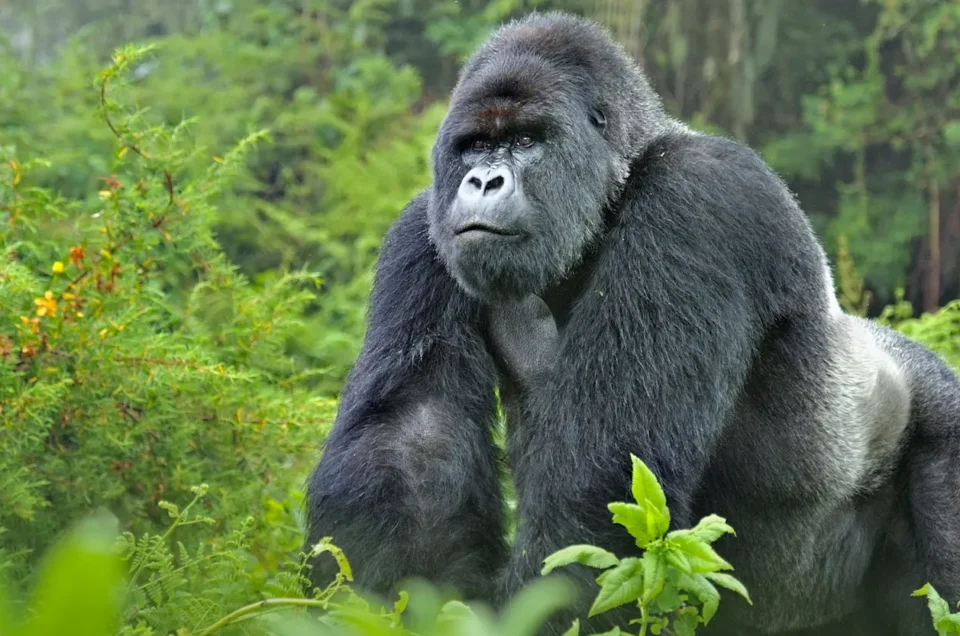
The star attraction is, of course, the mountain gorilla. In Volcanoes National Park, you can come face to face with these gentle giants in one of Africa’s most unforgettable wildlife experiences. The park is also home to the playful and endangered golden monkey.
In Nyungwe National Park, you can track chimpanzees and look for some of the forest’s other primates. In total, the park is home to 13 different primate species, making it one of Africa’s most important rainforest habitats.
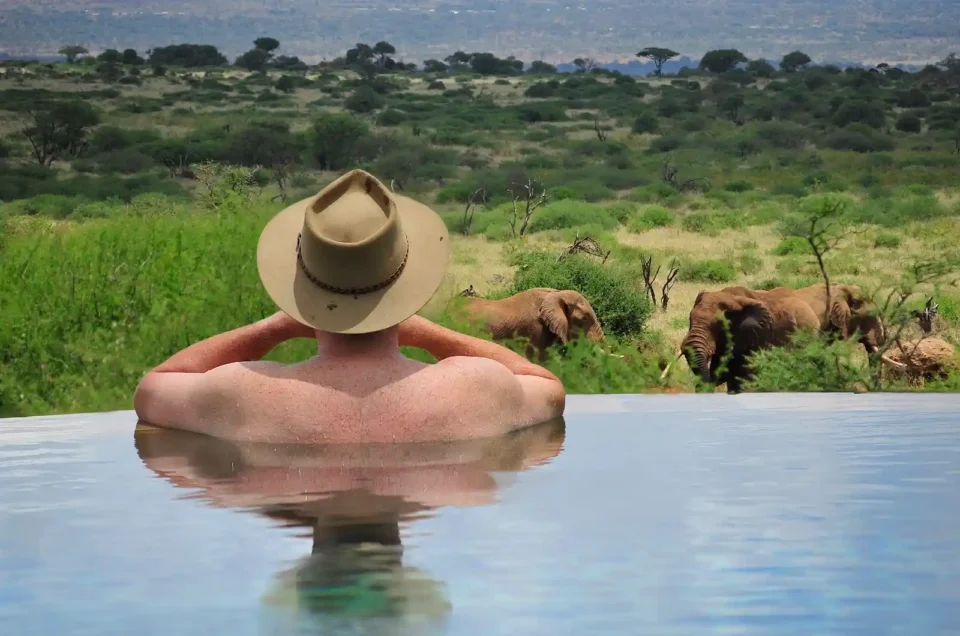
If you dream of a classic African safari, Akagera National Park will not disappoint. Here, you have the chance to see the Big Five (lion, leopard, elephant, rhino, and buffalo) along with giraffes, zebras, hippos, crocodiles, and a wide variety of antelope.
Rwanda is also a bird watching paradise. More than 700 bird species have been recorded across the country, including many rare Albertine Rift endemics and the sought-after shoebill, which can occasionally be spotted in Akagera’s wetlands.
How many days do I need for a Rwanda safari?
To experience Rwanda properly, we recommend spending at least 7 to 10 days in the country.
This gives you enough time to explore Rwanda’s most famous parks and enjoy the incredible variety of landscapes and wildlife it has to offer.
A well-balanced itinerary usually includes a stay in Kigali, followed by two to three nights in Volcanoes National Park for gorilla trekking and golden monkey tracking. From there, you can continue to Nyungwe National Park for chimp trekking, rainforest walks, and the famous canopy walkway. Finish your journey in Akagera National Park, where you can enjoy classic safari game drives in search of the Big Five.
If you have a little more time, 10 to 12 days is ideal. The extra days allow you to travel at a more relaxed pace, spend longer in each park, and fully appreciate the beauty and diversity that make Rwanda so special.
The more time you have, the more Rwanda reveals its magic.
Is Rwanda safe for travellers?
Yes. Rwanda is one of the safest and most welcoming destinations in Africa.
You will find clean cities, well-maintained roads, and a tourism industry that is organized and easy to navigate. Crime affecting visitors is very rare, and many travelers are pleasantly surprised by how safe and comfortable they feel while exploring the country.
English is widely spoken, alongside Kinyarwanda, French, and Swahili, making communication straightforward for most visitors.
Rwanda is also known for its strong commitment to environmental protection. Plastic bags are banned nationwide, and the country takes great pride in keeping its towns, cities, and natural areas exceptionally clean.
As with any destination, it is always wise to take normal precautions, especially when exploring unfamiliar areas after dark. However, for the vast majority of visitors, Rwanda is a safe, friendly, and stress-free place to travel.
Many travelers arrive for the gorillas and wildlife, but leave equally impressed by the country’s sense of safety, cleanliness, and warm hospitality.
Should I trek for gorillas or chimps, or both?
If you have the opportunity, we highly recommend doing both.
While both experiences involve tracking primates in the wild, they are completely different and equally rewarding.
Gorilla trekking in Volcanoes National Park is often the highlight of a trip to Rwanda. The experience feels calm, intimate, and deeply moving. After your trek, you spend one unforgettable hour with a habituated gorilla family, watching them feed, play, groom, and interact with one another.
Chimp trekking in Nyungwe National Park is far more energetic. Chimps move quickly through the forest, and tracking them can be an adventure in itself. Watching our closest relatives communicate, forage, play, and swing through the trees is an incredible experience.
Many travelers wonder which one to choose. The truth is that they complement each other perfectly. Gorillas offer a powerful and emotional encounter. Chimps provide excitement, energy, and fascinating behavior.
That is why many of our guests choose to do both. In fact, most tell us afterwards that they would not want to have missed either experience.
The good news is that Rwanda makes it easy to combine gorilla trekking, chimp trekking, and even a Big Five safari into one unforgettable journey.
Which destinations can I combine with a Rwanda safari?
Rwanda combines beautifully with several of East Africa’s most iconic destinations.
Uganda is a natural choice. The two countries share the same mountain gorilla ecosystem, and Uganda also offers excellent chimp trekking, diverse wildlife, and stunning landscapes.
Tanzania is perfect if you want to combine Rwanda’s rainforest experiences with a classic African safari. After tracking gorillas and chimps, you can continue to the Serengeti in search of the Big Five, and finish your journey on the white-sand beaches of Zanzibar.
Kenya is another excellent option. Pair Rwanda’s misty mountains and forests with the vast plains of the Maasai Mara, one of Africa’s most famous safari destinations.
The contrast between these destinations is what makes the combination so special. One day, you are standing face to face with a mountain gorilla in the rainforest. A few days later, you are watching lions on the savannah or relaxing beside the Indian Ocean.
Whether you have one week or several, we can create a seamless itinerary that combines Rwanda with Uganda, Tanzania, Kenya, or a mix of destinations to match your interests, travel style, and available time.
Do I need vaccinations for a Rwanda safari?
Before traveling to Rwanda, we recommend consulting your GP or travel clinic well in advance for the latest medical advice and vaccination recommendations.
Yellow Fever: Rwanda itself is not considered a yellow fever country, and a yellow fever vaccination is generally not required. However, if you are arriving from or have recently traveled through a country where yellow fever is present, you may be asked to show proof of vaccination upon arrival.
Malaria: Malaria does occur in Rwanda, particularly in lower-lying areas such as Akagera National Park. Higher-altitude regions, including parts of Nyungwe National Park, are generally considered lower risk.
We recommend speaking to your doctor about suitable malaria prevention medication before your trip. It is also wise to wear long sleeves and trousers in the evenings and use insect repellent, especially around dusk when malaria-carrying mosquitoes are most active.
After returning home, if you develop flu-like symptoms, headaches, fever, or nausea within a few weeks of travel, seek medical advice immediately and inform your doctor that you have recently visited Africa.
What are the passport and visa requirements for Rwanda?
Traveling to Rwanda is refreshingly simple.
Visitors from most countries can obtain a visa on arrival, making entry into the country straightforward and hassle-free. In many cases, there is no need to arrange a visa before you travel.
Citizens of African Union member states, Commonwealth countries, and La Francophonie nations are generally eligible for a complimentary 30-day visa on arrival. Citizens of East African Community countries can stay for up to six months without charge. Several other nationalities, including those from Singapore, Mauritius, and Ghana, are eligible for a free 90-day visa.
If required, visas can also be obtained online through Rwanda’s official visa portal or through a Rwandan embassy or consulate before departure.
Before you travel, make sure your passport is valid for at least six months beyond your intended travel dates. It is also advisable to have at least three blank pages available for entry and exit stamps.
As visa regulations can change, we always recommend checking the latest requirements with the relevant authorities before you travel.
What are the practical travel essentials for Rwanda?
Here are a few simple things you should know before you travel to Rwanda.
Currency: The local currency is the Rwandan franc (Rwf). However, US dollars are widely accepted, especially for major expenses like gorilla permits and higher-end accommodation. Visa cards are generally more widely accepted than Mastercard. You will find ATMs in Kigali and other major towns. Currency exchange is available at banks and forex bureaux, although they are usually closed on Sundays and public holidays.
Electricity: Rwanda uses 230V power. The most common plug types are Type C (two round pins) and Type J (three round pins). Most lodges provide in-room charging points. However, in remote areas, power may come from solar systems. In these places, charging is often done in shared areas, and high-power appliances like hair dryers may not always be supported.
Communication: Rwanda has some of the best mobile and internet coverage in Africa. Local SIM cards from MTN and Airtel are inexpensive and easy to buy. You will find strong 4G coverage in cities and good Wi-Fi in most hotels. In remote lodges, speeds can vary, but emergency communication is always available.
Time Zone: Rwanda operates on GMT +2 with no daylight-saving time. Daylight hours remain fairly consistent throughout the year.
Plastic & Water: Plastic bags are not allowed in Rwanda, so bring reusable cloth bags. It is best to drink bottled or filtered water, although bottled water is widely available in towns and lodges.
Which airports serve Rwanda?
Kigali International Airport is Rwanda’s main international hub, located 10 km east of the Kigali city centre; approximately 20–40 minutes by car depending on traffic. It has full facilities, including duty-free, car rental, ATMs, currency exchange, cafes, and a VIP lounge.
Smaller regional airports include Kamembe International Airport near Cyangugu in the southwest (a useful gateway to Lake Kivu and Nyungwe), Gisenyi Airport near Lake Kivu in the northwest, and Huye Airport in the south. Several airstrips, including Gabiro, Nemba, and Ruhengeri, serve charter flights and provide domestic connectivity to areas close to the national parks.
Have more questions?
Contact us. Our team of experts are here to help! Whether you’re curious about the best time to travel, want to hear first-hand about an experience or need help planning your safari.
Rwanda Travel Guides
Greenway nature tours
We are a fully licensed tour company accredited by the Uganda Tourism Board. We design and operate safaris in Uganda and East Africa. Our operations are based in Kampala, Uganda, the heart of our safari planning and coordination. Though our company was officially established in 2025, our team brings deep, hands-on knowledge of East Africa.
Destinations
Favourite Tours
Help & Info
- About us
- Travel Blog
- Travel FAQS
- Gorilla Permits Bookings
- Contact Us
- Pay Online