The Great Migration Safaris
The Great Migration in Kenya and Tanzania is an impressive spectacle of millions of animals following the plains in search of fresh grass.
The Great Migration in Tanzania and Kenya
The Great Migration takes place every year in Kenya and Tanzania. An immense migration of approximately 1.5 million wildebeest and 200,000 zebras. A spectacle comprising herds of about 40-50 kilometers in length, closely followed by predators such as hyenas, lions, and jackals, who lie in wait for their chance among the weaker animals. This natural phenomenon is known worldwide as The Great Wildebeest Migration. It is impossible to say precisely when the migration takes place. It is an unpredictable and spontaneous event, linked to the arrival of the rains.
The short rainy season
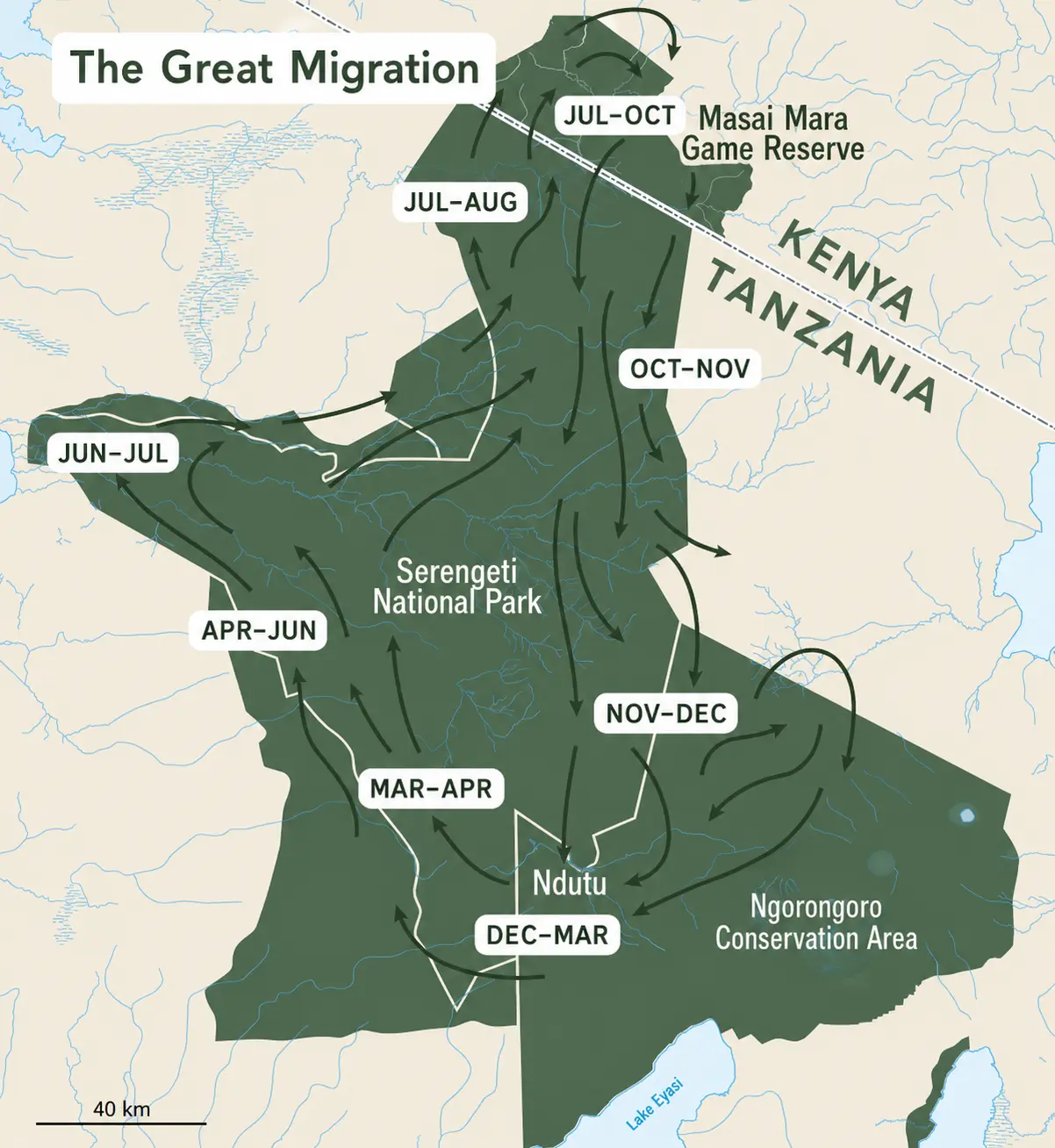
The short rainy season begins around mid-October. The first herds start moving south from the Masai Mara National Reserve in Kenya toward the lush grasslands of the southeastern Serengeti National Park, around Lake Ndutu. Here, the migration slows down and the herds spread across the plains. This area becomes a major feeding ground, and predators take advantage of the large concentrations of prey. It is also calving season. Thousands of wildebeest calves are born on the Ndutu plains, where fresh grass supports their early growth. By mid-March, the grass has been heavily grazed. The herds then begin to move westward again, continuing the cycle of the Great Migration.
The Great Migration
The calving season happens in January and February. Thousands of young wildebeest are born during this time, marking a key stage in the migration cycle. In April and May, the herds move through the area between the Moru Kopjes and the western Seronera Valley in the Serengeti. The landscape becomes a busy corridor of moving wildlife. By June, the migration often splits. A smaller group heads north, while the larger herds continue west toward the Grumeti River. Here, they face one of the first major challenges: crossing the river, where crocodiles lie in wait. In early July, the herds reunite further north. They continue toward the Mara River in northern Serengeti and the Masai Mara in Kenya. River crossings are dramatic and dangerous. Some animals are eaten by crocodiles, while others are injured in the chaos of the crossing.
River crossings
Witnessing a river crossing requires a lot of patience and a lot of luck; it can sometimes take many days before the herds start moving! The animals that make the crossing remain in the Masai Mara until the end of October. Incidentally, many other animal species, such as gazelles, giraffes, and birds of prey, often have a fixed territory. They therefore do not migrate, ensuring there is always plenty to see throughout the park
The Great Migration in Africa
It is not possible to predict exactly where the herds will be at any given time. The migration depends entirely on rainfall. Because of this, timing and location can shift by four to eight weeks from year to year. The migration map only gives a general idea of movement under normal conditions. In reality, not all wildebeest and zebras follow the same route. The herds often split into smaller groups. Some move ahead, while others take longer or shorter paths. If rains fail in one area, they may even turn back. Trips can be adjusted to improve your chances of seeing the migration or parts of it.
Wildlife
The migration also attracts many predators. Lions, hyenas, and cheetahs closely follow the herds. They take advantage of the constant movement and large numbers of prey.
This creates dramatic and ever-changing safari scenes. No two safaris are the same, even within the same season. Conditions can change quickly, so flexibility is important. With local knowledge and experience, it is possible to be in the right place at the right time to witness the Great Migration in Africa.
Great Migration Trips in Africa
Greenway nature tours
We are a fully licensed tour company accredited by the Uganda Tourism Board. We design and operate safaris in Uganda and East Africa. Our operations are based in Kampala, Uganda, the heart of our safari planning and coordination. Though our company was officially established in 2025, our team brings deep, hands-on knowledge of East Africa.
Destinations
Favourite Tours
Help & Info
- About us
- Travel Blog
- Travel FAQS
- Gorilla Permits Bookings
- Contact Us
- Pay Online