Which primates live in Uganda? From mountain gorillas to baboons
Anyone on safari in Uganda will almost certainly encounter primates. Sometimes a group of olive baboons sits by the roadside, and moments later, black-and-white colobus monkeys leap through the trees near your accommodation. But there are also primates you consciously venture into the jungle to see, such as mountain gorillas, golden monkeys and chimpanzees. It is exactly this diversity that makes Uganda so interesting for primate enthusiasts. In this blog, you will know which primate species live in Uganda, where you can find them, and for which encounters you should plan a trek.

Which primates live in Uganda?
In Uganda, you will find a wide variety of primates.
This is partly because of its diverse landscapes, from tropical rainforest and mountain forests to wetlands and open savannas. Each habitat is home to different species. In Kibale Forest, for example, you can encounter several kinds of monkeys during a single walk. In the savannas of Murchison Falls or Queen Elizabeth National Parks, you will find quite different species.
The best-known primates in Uganda are, of course, the mountain gorilla and the chimpanzee. Both belong to the great ape family. Also, there are golden monkeys, colobus monkeys, olive baboons, blue monkeys, red-tailed monkeys, and several other species. Some are rare and reside only in particular areas, while others are common and can often be spotted along the way.
One of the nice things about seeing primates in Uganda is that you don’t need to book a special activity for nearly all them. You can encounter many species during a forest walk, a game drive, or simply from the grounds of your lodge.
For mountain gorillas, chimpanzees, and golden monkeys, however, it is different. To see them, you join a guided trek with specialised rangers and need to obtain a permit.
Overview: where can you see which monkeys in Uganda?
Monkeys for which you need a trekking and permit
Mountain Gorillas
Best spots: Bwindi Impenetrable Forest and Mgahinga Gorilla National Parks
How do you see them? Gorilla trekking with a gorilla permit
Chance of encounter: Very high during a trek
Chimpanzees
Best spots: Kibale Forest, Budongo Forest, Kalinzu Forest and Kyambura Gorge
How to see them? Chimpanzee trekking with a permit
Chance of encounter: Very high in Kibale Forest National Park
Golden Monkeys
Best place: Mgahinga Gorilla National Park
How do you see them? Golden monkey trekking with a permit
Chance of encounter: Very high during a trek
Monkeys you might encounter during Forest walks and Savannah game drives
Black-and-white colobus monkeys
Best places: Kibale Forest, Bigodi Wetland, and other wooded areas
How do you see them? During a forest walk or on the road
Chance of encounter: High in suitable places
Olive Baboons
Best spots: Queen Elizabeth, Murchison Falls, and Kibale Forest National Parks
How to see them? Along the road or during a game drive
Chance of encountering them: Almost certain during an extensive tour
Vervet monkeys
Best places: Savannah areas, lodges, and villages
How do you see them? On the road or during a game drive
Chance of encountering: High
Uganda Mangabeys
Best places: Kibale Forest, Bugoma Forest, and Budongo Forest
How do you see them? During a forest walk
Chance of encounter: Varies
L'Hoest's monkeys
Best spots: Kibale Forest and Bwindi Impenetrable Forest National Parks
How do you see them? During a forest walk
Chance of encounter: Fair
Red-tailed monkeys
Best places: Kibale Forest, Bigodi Wetland, and other wooded areas
How do you see them? During a forest walk
Chance of encounter: High in suitable forests
Red colobus monkeys
Best spot: Kibale Forest National Park
How do you see them? During a forest walk
Chance of encounter: Varies
Blue monkeys
Best places: Bwindi Impenetrable Forest and other mountain forests
How do you see them? During a forest walk
Chance of encounter: Fair
Patas monkeys
Best spots: Murchison Falls and Kidepo Valley National Parks
How do you see them? During a game drive
Chance of encountering them: Varies
These are the main primate species you might encounter as a traveler. The chances are indications and depend on the location, the activity, and the time you spend in a particular location. When trekking to a group accustomed to human presence, the chances are generally much higher than during a chance encounter while walking.
Three special Primates in Uganda for which you go on a trek
Chimpanzees: the most lively encounter
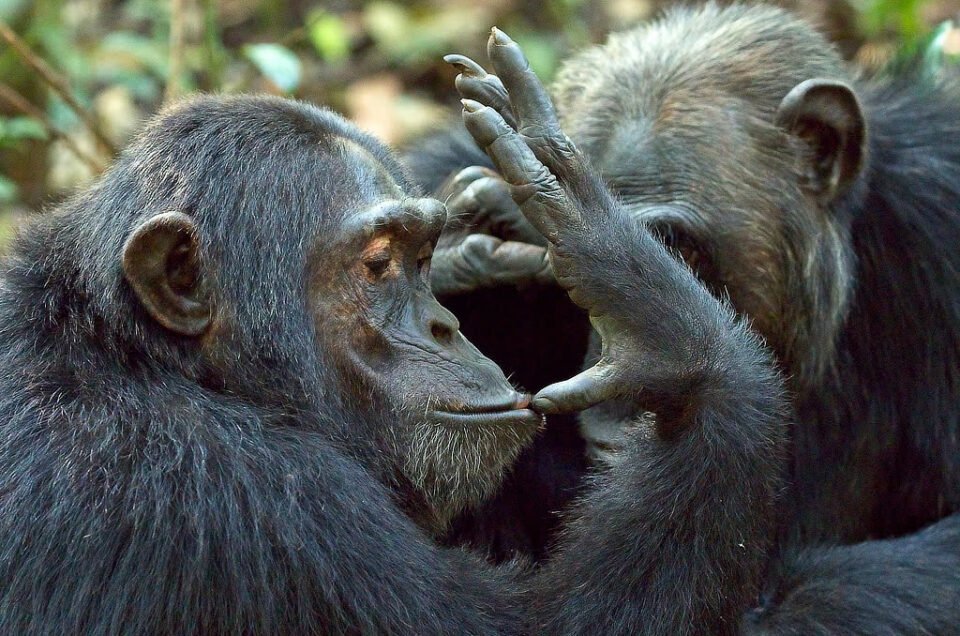
Chimpanzees sometimes behave surprisingly like humans. They communicate through sounds, facial expressions, and gestures. They form friendships, quarrel, and make up again. You can observe their interpersonal relationships, cooperation, and sometimes quite a bit of drama. This is what makes observing chimpanzees so fascinating.
Moreover, a trek to see chimpanzees is a very different experience from a visit to mountain gorillas. Chimpanzees are often constantly on the move. They climb through the trees, call one another, and can suddenly cover a considerable distance through the forest. Sometimes you can hear their calls from far away before you have even seen a single chimpanzee.
In our opinion, Kibale Forest National Park is the best place for chimpanzee trekking in Uganda. Many chimpanzees live there, and the chances of seeing them during a guided trek are particularly high. Budongo Forest, Kalinzu Forest and Kyambura Gorge in Queen Elizabeth National Park also offer opportunities to see chimpanzees, but the experience and chances of an encounter vary by area.
You need a permit for chimpanzee trekking. You set off with a ranger and, once you find the chimpanzees, you normally have one hour to observe them. Would you like to know more about the different locations, what to expect during the trek and the costs? Then read our detailed guide to chimpanzees in Uganda.
Mountain gorillas: face to face with a gorilla family
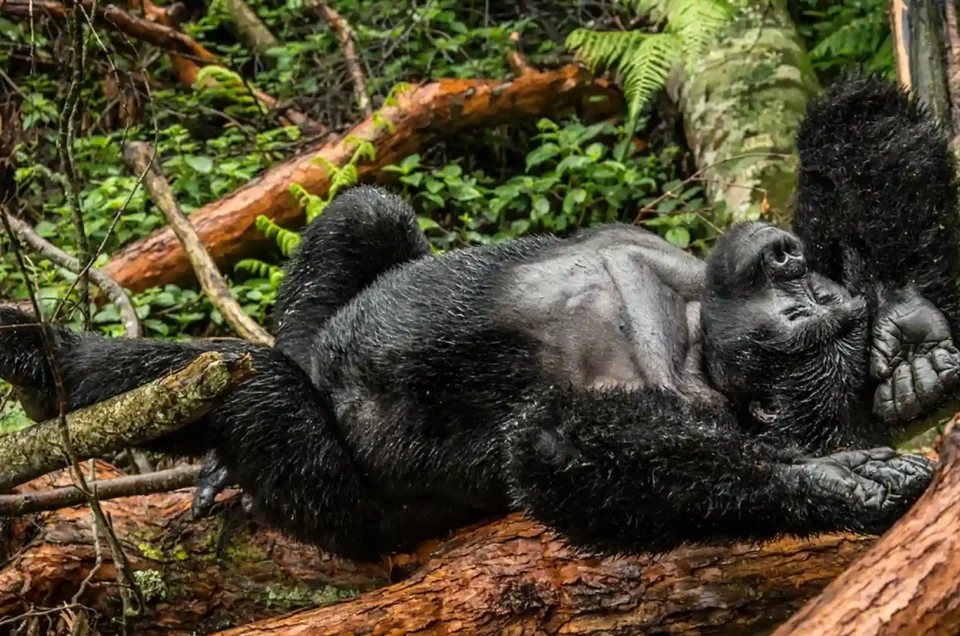
For many visitors, seeing mountain gorillas is the main reason to come to Uganda. An adult silverback sitting quietly as he feeds, baby gorillas tumbling over one another, and a mother keeping her baby close are just some of the moments that make a gorilla trek so memorable.
Gorillas are generally calmer than chimpanzees. While chimpanzees are often on the move, climbing through the trees and calling to one another, gorillas tend to spend more time feeding, resting and interacting with their family. It is exactly this calmness and the similarities to our own behavior that make the encounter so special.
In Uganda, mountain gorillas live in Bwindi Impenetrable National Park and Mgahinga Gorilla National Park. Accompanied by rangers and trackers, you walk through the rainforest in search of a gorilla family that is accustomed to human visitors. The trek may take less than an hour, but it can also last several hours, depending on where the gorillas are on that particular day.
Gorilla trekking requires a permit, which should be booked well in advance. The chances of seeing a gorilla family are very high, although the trek itself can be physically demanding. Once you find the family, you are allowed to spend a maximum of one hour with them. The minimum age for gorilla trekking in Uganda is 15.
You can find more practical information in guide to gorilla trekking.
Golden monkeys: little acrobats in the bamboo forests
Golden monkeys may receive less attention than mountain gorilla and chimpanzee, but these primates are at least as fun to watch. Their striking golden-orange fur makes them easy to recognise, and they are incredibly active. They move quickly through the bamboo, jumping between stalks, searching for food and sometimes stopping just a short distance from you.
Golden monkeys live in the Virunga Volcanoes, which stretch across Uganda, Rwanda and the Democratic Republic of Congo. In Uganda, you can visit them in Mgahinga Gorilla National Park. Accompanied by a ranger, you walk through the mountain forest and bamboo zones in search of a group that is accustomed to human visitors.
A permit is also required for golden monkey trekking. Once you find the group, you can spend one hour observing and photographing them. The chances of seeing the monkeys are generally high. This trek is particularly enjoyable for people who like wildlife photography, active monkeys and walking in the mountains.
If you are staying around Lake Mutanda or in the Kisoro area, golden monkey trekking is an easy activity to include in your itinerary. The drive to Mgahinga takes you through beautiful mountain scenery, making the journey itself a pleasant part of the day.
Read more in our guide to golden monkey trekking.
Which Primates do you just come across along the way?
You don’t have to venture deep into the rainforest for every primate species. One of the nice things about safari in Uganda is that you can constantly encounter wildlife, even outside the well-known treks. Sometimes during a nature game drive in the savannah, sometimes along the way, and sometimes simply in the trees around your lodge or camp.
Black-and-white colobus monkeys and other forest dwellers
The black-and-white colobus is one of the most beautiful monkeys you can see in Uganda’s forests. Its black body, long white hair and distinctive white tail make it easy to recognise, especially when it leaps between the trees. Colobus monkeys spend much of their time high in the canopy, where they feed mainly on leaves. You can spot them in Kibale Forest, around Bigodi Wetland and in several other forested areas of Uganda.
Another species to look out for on a walk in the woods is the red-tailed monkey. You can recognize them by their long reddish-brown tail, dark face, light cheeks, and the distinctive white spot on their nose. These small, active monkeys move quickly through the trees, feeding mainly on fruit, but also eating leaves, flowers and insects. So, as you walk, don’t just look at the path in front of you, but also look up carefully. Among the dense greenery, that reddish-brown tail in particular often reveals where they are.
Also, red colobus monkeys reside in Kibale Forest National Park, playing an important role in the ecosystem. They are on the menu of chimpanzees, who sometimes hunt these monkeys collectively. It is a less friendly, but fascinating aspect of chimpanzee behavior.
Blue monkeys are another species found in Uganda’s forests, including Bwindi Impenetrable Forest. Despite their name, they are not bright blue. Their coat is mainly greyish, with darker colouring on the face and head. Like the other smaller monkey species, they do not require a separate trekking permit. However, joining a guided forest walk gives you a better chance of spotting them and learning to recognise the different species.
Baboons and vervet monkeys: the monkeys you can hardly miss
Baboons are among the most familiar monkeys in Uganda. Large groups reside in Queen Elizabeth National Park, Murchison Falls National Park, and along several roads throughout the country. Sometimes they sit quietly by the roadside. Sometimes they trek through the landscape in groups of dozens. They are especially social primates with a clear group structure. If you watch for a moment, you will see them grooming each other, playing, fighting, or keeping an eye on one another. Young baboons, in particular, can cause quite a bit of unrest within a group.
Also, baboons are clever opportunists. They know exactly where people have food and can be quite bold. So, we always advise against feeding them and to store food properly. Once a baboon has discovered that a car or picnic spot yields something, it will not forget it easily.
Vervet monkey, also known as the green monkey, is another monkey you will frequently encounter during a tour through Uganda. They are smaller and slenderer than baboons, have grayish fur, a strikingly dark face and a long tail. You will often spot them in savannah areas, around lodges, and even in gardens and villages. They are quick, curious, and remarkably agile. As with other monkeys, it is best not to feed them.
Mangabeys and L'Hoest's monkeys: lesser-known monkeys
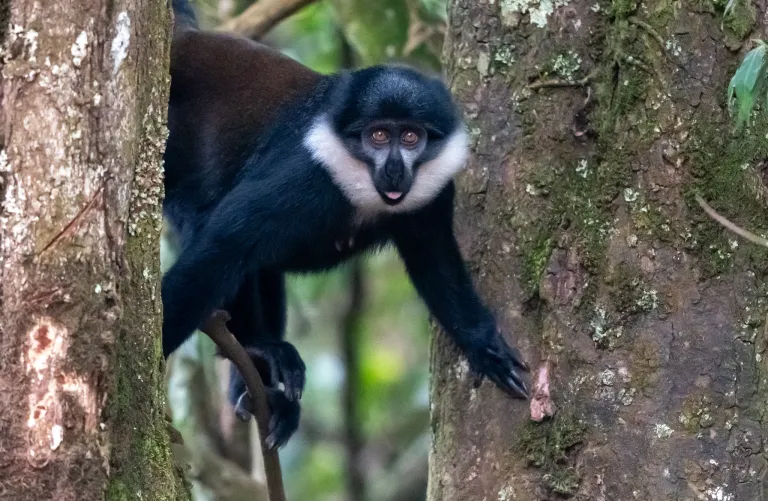
The Ugandan mangabey is one of the lesser-known monkeys you can encounter in the country’s forests. This monkey has a dark body, strikingly light cheeks, and a face that seems to have an expression of its own almost constantly. Mangabeys are active monkeys that search for food both in the trees and on the forest floor. They often move in groups. You can encounter them in Kibale National Park, among other places, but they are less predictable than baboons along the road.
Another interesting species is L’Hoest’s monkey. It has dark fur, a distinctive white beard and a long tail. You can find it in forests such as Kibale and Bwindi, where it often searches for food in the lower vegetation or on the forest floor. Unlike some of the more familiar monkeys, L’Hoest’s monkeys tend to be shy and can disappear into the vegetation before you get a good look at them. A good local guide will help you identify them and knows in which parts of the forest they are regularly seen.
Patas monkeys: monkeys of the open savannah
When people think of monkeys, they usually picture animals moving through dense rainforest or jumping between tree branches. Patas monkeys are different. They are well adapted to open savannah landscapes, where they spend much of their time on the ground. In Uganda, you can find them in Murchison Falls National Park and the northern parts of the country, including Kidepo Valley National Park.
With their long legs and slender bodies, patas monkeys are built for speed. In fact, they are among the fastest-running primates in the world. During a game drive, you might spot a group sitting in an open clearing, feeding in the grass or suddenly sprinting away when disturbed. Unlike baboons, which you can encounter quite frequently, patas monkeys are less commonly seen. That makes spotting one a particularly nice surprise during a safari.
Where can you see primates in Uganda?
Those who would like to see many primate species do not need to visit all national parks in Uganda. A few areas stand out and can also be easily combined during a tour.
Kibale Forest National Park and Bigodi Wetland
If you ask us where to go in Uganda for the greatest variety of primates, Kibale Forest National Park is at the top of our list. Besides chimpanzees, the forest is home to several primate species, including black-and-white colobus monkeys, red colobus monkeys, red-tailed monkeys, L’Hoest’s monkeys and mangabeys.
We regularly recommend combining a chimpanzee trek with a guided walk through nearby community-run Bigodi Wetland Sanctuary. During a walk here, it is quite common to spot four or more different monkey species. Unlike a chimpanzee trek, where the main focus is finding and observing the chimpanzees, a Bigodi walk gives you more time to look around and enjoy the different wildlife along the way. You can also learn about the wetland and its importance to the local community.
Kibale is an area we know particularly well. Between the forest, Bigodi Wetland, crater lakes and surrounding villages, you can easily spend several days here without running out of things to do.
For more information, read our detailed guide to Kibale Forest National Park.
Bwindi and Mgahinga
Southwestern Uganda is particularly interesting for anyone who wants to see mountain gorillas and golden monkeys. Bwindi Impenetrable National Park is home to mountain gorillas as well as several smaller monkey species, including black-and-white colobus monkeys and L’Hoest’s monkeys. Nearby, Mgahinga Gorilla National Park, in the Virunga Mountains, offers the opportunity to see golden monkeys in their natural habitat.
If you would like to see both mountain gorillas and golden monkeys, we can help plan your route to avoid unnecessary driving. Depending on the location of your gorilla trek, staying around Lake Mutanda can be a particularly good option. It provides a convenient base for visiting both parks while allowing you to enjoy one of the most beautiful parts of southwestern Uganda.
Queen Elizabeth and Lake Mburo National Parks
In Queen Elizabeth National Park, you often encounter baboons. Other monkey species also live in the more forested areas, and in Kyambura Gorge you can go on a chimpanzee trek.
Lake Mburo National Park is mainly a safari park for giraffes, zebras, and antelopes, but you can also encounter monkeys there, including vervet monkeys and bush babies. So, it is not a destination we travel to specifically for primates, but it is a place where you see other animals along the way.
What is the best primate tour in Uganda?
If you want to see as many different primate species as possible during your Uganda tour, we recommend structuring your trip primarily around Kibale National Park, Bwindi Impenetrable National Park, and Mgahinga Gorilla National Park. These are the places where you can do the most important primate treks and simultaneously encounter many smaller primate species.
A logical route might look like this, for example:
- Kibale Forest National Park: chimpanzee trekking and an extra forest walk or visit to Bigodi Wetland Sanctuary for other monkey species.
- Queen Elizabeth National Park: game drives for savannah animals and baboons and other monkeys along the way. Optionally, an extra chimpanzee trek in the forested Kyambura Gorge.
- Bwindi Impenetrable Forest National Park: gorilla trekking, with ample time to also enjoy the rainforest and the surroundings.
- Mgahinga Gorilla National Park: golden monkey trekking in the Virunga Volcanoes, optionally combined with a volcano hike.
- Lake Mburo National Park: finish with a walking safari among giraffes and zebras, before traveling back towards Entebbe.
Depending on how many days you have, you can extend the route to include Murchison Falls National Park or other areas. However, we do not advise planning exclusively as many primate activities as possible back-to-back. It is precisely the variety—including a boat safari, game drives, hike, or a quiet afternoon at the lodge—that makes a tour enjoyable.
You also don’t necessarily have to do every possible trek. Anyone who has already had a wonderful encounter with chimpanzees in Kibale Forest can choose to spend most of their time in Queen Elizabeth National Park on the savannah and the Kazinga Channel.
Do you always need a permit to see primates?
No. For many primate species, you don’t need to arrange anything special. You often encounter baboons and vervet monkeys during a safari. For smaller forest primates, a guided nature forest walk can be helpful, for which an entrance or activity fee sometimes applies.
For three special activities, you must reserve a permit in advance:
- Gorilla trekking: mandatory in Bwindi or Mgahinga, with a minimum age of 15 years.
- Chimpanzee trekking: mandatory on organized treks, for example in Kibale.
- Golden monkey trekking: mandatory in Mgahinga, with a minimum age of 12 years.
Gorilla permits, especially, are in limited supply. Therefore, it is advisable you book them well in advance of departure. We also prefer to plan chimpanzee trekking and golden monkey trekking in advance so that the activities fit well into the itinerary.
Our tour guides often see more than just the well-known Primates.
A good tour guide can make a real difference, especially when you are interested in wildlife beyond the well-known animals. Of course, seeing a mountain gorilla or chimpanzee is a highlight of any Uganda safari. But there is plenty more to notice along the way, particularly if you know where to look.
Our guides know the national parks well and are always happy to share their knowledge of the animals and their behaviour. Take the red colobus, for example. These monkeys often live high in the forest canopy and feed mainly on leaves. They are also an important prey species for chimpanzees, which sometimes hunt them in groups. Knowing a little about these relationships makes seeing the monkeys even more interesting. You are not just looking at an animal; you are getting a glimpse of how life in the forest works.
And the wildlife encounters do not stop when a planned activity ends. Our guides keep their eyes open throughout the journey. They might spot colobus monkeys in the trees near your lodge, baboons beside the road or vervet monkeys playing around a campsite. Sometimes, a short stop to watch these animals becomes one of those lovely moments you remember long after your safari.
A safari in Uganda with a focus on primates
If you would like to see primates, we can tailor the route accordingly. That does not automatically mean you have to book as many treks as possible. Sometimes an extra morning hike in Kibale Forest National Park yields more than another long travel day to the next park.
At Greenway Nature Tours, we organize fully customized private safaris in Uganda from Kampala. Together, we determine which primate species you would like to see, how many hikes you want to take, and how to combine that with the rest of the country.
Would you like to see gorillas, chimpanzees, and golden monkeys, but also have time for a beautiful safari and other experiences? Then we can help you put together an itinerary where everything flows together logically. Feel free to contact us to discuss the possibilities.
You might also be interested in these articles:
Greenway nature tours
We are a fully licensed tour company accredited by the Uganda Tourism Board. We design and operate safaris in Uganda and East Africa. Our operations are based in Kampala, Uganda, the heart of our safari planning and coordination. Though our company was officially established in 2025, our team brings deep, hands-on knowledge of East Africa.
Destinations
Favourite Tours
Help & Info
- About us
- Travel Blog
- Travel FAQS
- Gorilla Permits Bookings
- Contact Us
- Pay Online